How to respond to a bad Google review (without making it worse)
How to respond to a negative Google review: a calm reply template, when to report it for removal, the privacy trap, and what Australian rules say.
By the Omniwink team · 21 October 2026 · 10 min read
Listen to the summary· 2 min
To respond to a negative Google review (a bad one, whether fair or not), wait until you are calm, reply once in a few polite lines, thank the reviewer, acknowledge what they said, and offer to sort it out by phone or email. Do not argue in public, do not offer a deal, and do not reveal anything about the customer.
That one reply is read by every future customer who looks at your profile, not only the person who wrote the review. So the goal is not to win. It is to look like a business that listens. This guide gives you a simple reply formula, example wording, the one privacy mistake that has landed an Australian business in trouble, and when it is worth reporting a review instead of replying. It is general information, not legal advice.
How should you respond to a negative Google review?
Business.gov.au gives two pieces of advice. Respond promptly, but take the time to draft a carefully written response. And be professional, because getting into a public argument online could hurt your reputation [4]. Google's advice for negative reviews is similar: reply in a timely manner, because a prompt response shows you value feedback, and keep it brief, polite and personal [1].
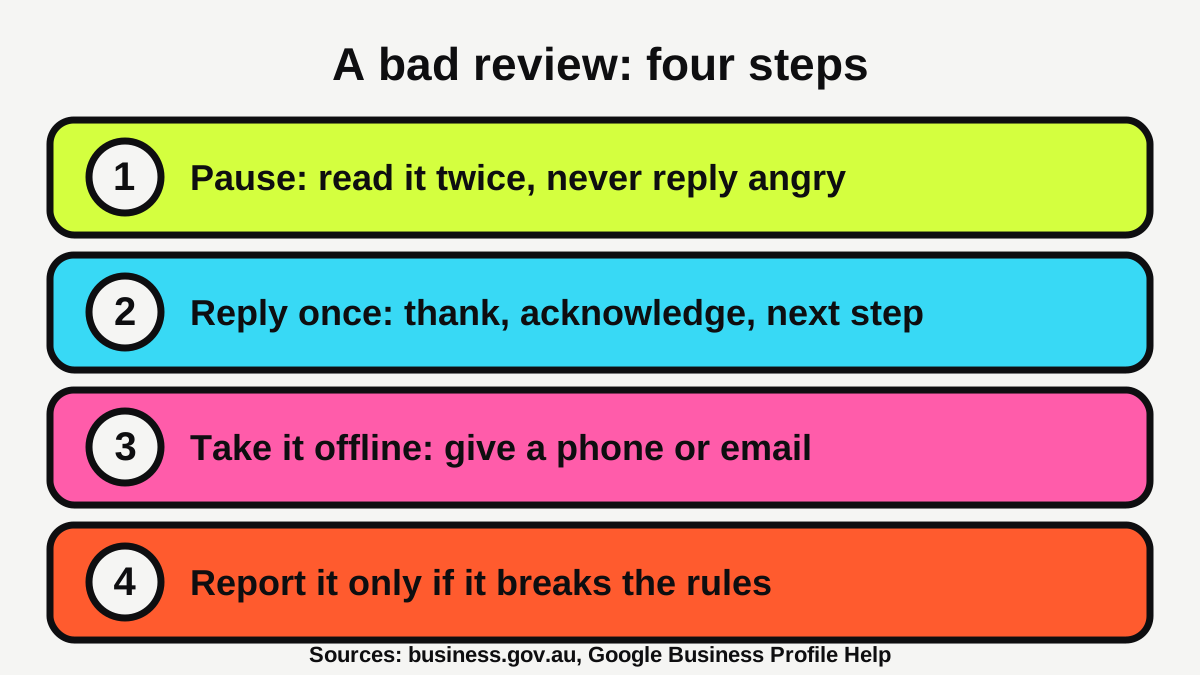
In practice:
- Pause. Read the review twice. Do not write the reply while angry.
- Reply once, using the four-part formula below.
- Take it offline. Give a phone number or email so you can fix it properly.
- Report it only if it genuinely breaks Google's rules.
What should a reply to a bad review say?
Google says to personalise your reply by addressing the reviewer by name and acknowledging their specific feedback [1]. It also says to be conversational, not promotional, and to avoid using your reply to offer deals or promotions [1]. Put that together and you get four short parts:
- Thank them and use their name.
- Acknowledge what they raised, in plain words, without arguing.
- Say what happens next: you will look into it, or you would like to talk it through.
- Give a way to reach you, then stop.
What does that sound like in real life?
A late tradie:
"Hi Sam, thanks for telling us. You're right that we arrived later than we said, and we should have rung ahead. I'd like to make this right. Please call me on [number] so I can sort it out. Jo, [business name]."
A cafe, where the complaint is about the coffee:
"Hi Priya, thanks for the feedback. We're sorry the coffee wasn't what you expected. We'd like to hear more, so please email [address] and we'll look into it with the team. Jo."
A review with a star rating and no words:
"Hi, thanks for taking the time to rate us. We're sorry your visit wasn't great. If you can share what happened, we'd like to put it right: [number]."
Notice what is missing: no excuses, no blame, no "as you can see from our five-star average". Short and humble works better than a long defence.
Does the tone change if the review is unfair?
Not much. WA Consumer Protection says it is best to respond calmly and constructively to genuine negative reviews, to show customers you take service seriously [5]. If the customer is wrong about the facts, you can state a fact once and politely. Stay short, and invite them to call. Readers will judge your tone more than your argument.
What should you check before you write anything?
A few minutes of checking makes the reply better and safer. None of this is a rule, just a routine that works:
- Find the job. Look up the customer by name, date and what they describe. Is it a real customer? If you cannot find anyone who matches, that points towards a review to report rather than answer.
- Get the facts straight. Ask whoever did the work what happened. A reply that gets a detail wrong makes things worse.
- Decide what you can offer. A call back, a re-do, a refund or an apology are yours to decide. Settle it first, so your reply promises only what you will do.
- Write it, then sleep on it if you can. Business.gov.au's advice to draft a carefully written response applies even when the review stings [4].
- Check it for personal details. Read your draft once more against the privacy section below [6].
Many small businesses find a saved starting point helps, so you are not writing from nothing at 9pm. Keep the four-part formula in a note on your phone and fill in the names.
Why does a calm reply matter if the reviewer never sees it?
Because other people do. Google says helpful and positive replies to reviews can show that you are responsive to your customers [2]. A new customer scanning your profile will often read the worst review and your reply side by side. A short, courteous answer says more about how you treat people than the star rating does.
It also helps to keep the review in proportion. One bad review among many good ones is normal. The way to dilute it is to ask every happy customer for an honest review, which is the subject of our guide to how to get more Google reviews. Our guide on how to follow up a quote without being pushy uses the same calm, helpful tone, and it works just as well after a complaint.
What is the privacy mistake that gets businesses in trouble?
Replying with details about the customer. The OAIC (the Australian privacy regulator) describes a case where a tenant left a negative Google review, and the real estate agency replied by disclosing his full name, occupation and financial circumstances [6]. The agency refused to delete the response, and the tenant complained. The OAIC found the agency had interfered with his privacy under Australian Privacy Principle 6, which limits using personal information for purposes other than the one it was collected for [6]. The agency was ordered to give a written apology within 30 days, though no compensation was awarded [6].
The OAIC's message is plain: it is not right to expose someone's personal information to pressure them into modifying or deleting an adverse online review [6]. It also notes that businesses can respond to the concerns in a review without identifying the reviewer or revealing any of their personal details [6].
So in your reply, do not mention:
- what they bought, booked or paid, beyond what they already said;
- anything from their file, quote, health record or account;
- their address, job or personal circumstances.
This matters most for businesses that hold sensitive records, such as dentists, physios, accountants and mortgage brokers.
When can you get a bad review removed?
Only when it breaks Google's rules. Google says only reviews that violate its policies are eligible for removal, and that disagreeing with a review or disliking it is not a valid reason to report it [3]. A rude or unfair review from a real customer will usually stay.
How do you report a review?
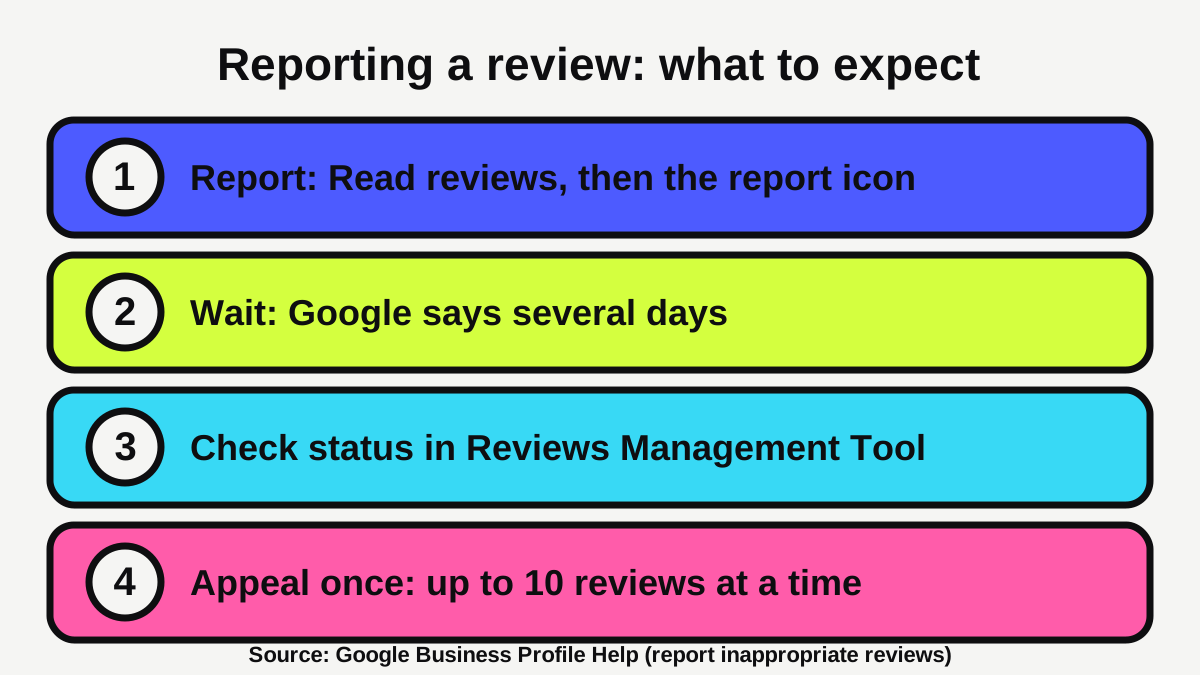
Google's steps, for reviews you believe break its policies [3]:
- Open your Business Profile and select Read reviews.
- Choose the Report icon next to the review and pick a reason.
- Select Send report.
You can also flag reviews in the Reviews Management Tool [3]. Google says the evaluation usually takes several days, and the tool can show a report as "Decision pending", "Report reviewed - no policy violation" or "Escalated" [3].
What if Google says no?
If a flagged review is not removed, Google says you can submit a one-time appeal through the Reviews Management Tool, for up to 10 reviews at once [3]. If the review violates policy it is removed. If it complies, it stays live, and you get an email with the result [3].
What about a fake review?
Under the Australian Consumer Law, it is illegal to create or arrange a fake or misleading review [4]. If you believe a negative review is fake, WA Consumer Protection suggests starting by contacting the platform and identifying which reviews you believe are fake. It also suggests you may want to respond publicly to correct the public record [5].
Here is how the options compare:
| Situation | Best move |
|---|---|
| Real customer, fair complaint | Reply calmly, fix it, follow up |
| Real customer, unfair or rude | Reply briefly and politely; report only if it breaks the rules |
| Someone who never used you | Report it, and reply briefly to correct the record |
| Someone demanding money to change it | Do not pay; report it to the platform and ScamNet |
What if someone demands money to remove a review?
Do not pay. WA Consumer Protection describes scammers who leave a fake one-star review and then demand payment to change it to five stars. It says businesses should never pay, because it will only encourage further extortion, and to report it to the review platform and to WA ScamNet [5].
Can you ask the customer to change their review?
You can fix the problem, then follow up politely. Business.gov.au suggests following up after you resolve the issue, because the customer may update their review [4]. That is their choice. Do not offer anything in return: our guide on whether you can offer a discount for a review explains why.
Two lines you must not cross. Google strictly prohibits offering incentives, such as free or discounted goods or services, in exchange for reviews. That includes incentives to change reviews or remove negative ones [1]. And on the legal side, business.gov.au lists a review that is removed or changed by you, or someone else, after a customer posts it as a sign of a fake or misleading review [4]. Our guide to how to get more Google reviews covers the full rules on asking.
What if you run a health business?
Health practitioners have extra rules. Ahpra says advertisers should take care if they choose to engage with reviews on third-party websites. It also says advertisers do not have to remove or try to remove a review on a website or in social media, and are not responsible for removing testimonials [7]. In practice: keep any reply short, never discuss clinical care in public, and check Ahpra's page before you respond.
What are the common mistakes?
- Replying in anger. Business.gov.au warns that a public argument could hurt your reputation [4].
- Arguing the facts at length. One calm correction is enough.
- Revealing customer details. See the OAIC case above [6].
- Offering a discount in the reply. Google says not to use replies to offer deals [1].
- Ignoring it. A bad review with no reply reads as "we don't care".
- Chasing five-star reviews from friends to push it down. That risks fake review problems [4]. A better fix is a steady flow of genuine reviews from real customers.
What to do next
- Read the review slowly, and take time to draft a careful reply [4].
- Write a reply in four parts: thank, acknowledge, next step, contact [1].
- Leave out any personal details about the customer [6].
- Ring them if you can, and fix the problem.
- Report the review only if it breaks Google's rules [3].
- Make a habit of reviews: our free Google review link tool makes it easy for happy customers to say so, and a calm reply habit pairs well with replying fast to enquiries.
If reviews and your Google profile feel like a chore, our free website scan is a quick place to see where you stand, and our growth service can handle the ongoing work.
Make leaving a review one tap.
Our free Google review link generator gives you a direct link and a QR code for your Business Profile, ready to text, email or print.
Sources
- [1]Tips to get more reviews · Google Business Profile Help · accessed 21 October 2026
- [2]Manage customer reviews · Google Business Profile Help · accessed 21 October 2026
- [3]Report inappropriate reviews on your Business Profile · Google Business Profile Help · accessed 21 October 2026
- [4]Online reviews · business.gov.au (Australian Government) · accessed 21 October 2026
- [5]From the Commissioner: The good, the bad and the fake - what to know about online reviews · Consumer Protection, Government of Western Australia · accessed 21 October 2026
- [6]Exercise caution when responding to negative reviews · Office of the Australian Information Commissioner (OAIC) · accessed 21 October 2026
- [7]Testimonials: Understand the requirements · Ahpra (Australian Health Practitioner Regulation Agency) · accessed 21 October 2026