How to follow up a quote without being pushy
Follow up a quote within a day or two, then again after about a week, and ask a real question each time. A simple Australian routine, with example messages.
By the Omniwink team · 18 October 2026 · 11 min read
Listen to the summary· 2 min

How do you follow up a quote without being pushy? Check in within a day or two to make sure the quote arrived, follow up again after about a week with something useful, and then send one polite final message before you stop. Being persistent is fine. Being pushy is repeating the same line, chasing at odd hours or ignoring a clear "no".
That rhythm works because most people who go quiet after a quote have not said no. They are busy, comparing a few options, or waiting on a partner or a landlord. This guide shows you when to follow up a quote, what to say, which channel to use, the rules to keep in mind in Australia and the mistakes that make good businesses look desperate. If you have not yet replied to the original enquiry quickly, start with our guide to lead response time, because a slow first reply makes every later follow-up harder.
When should you follow up a quote?
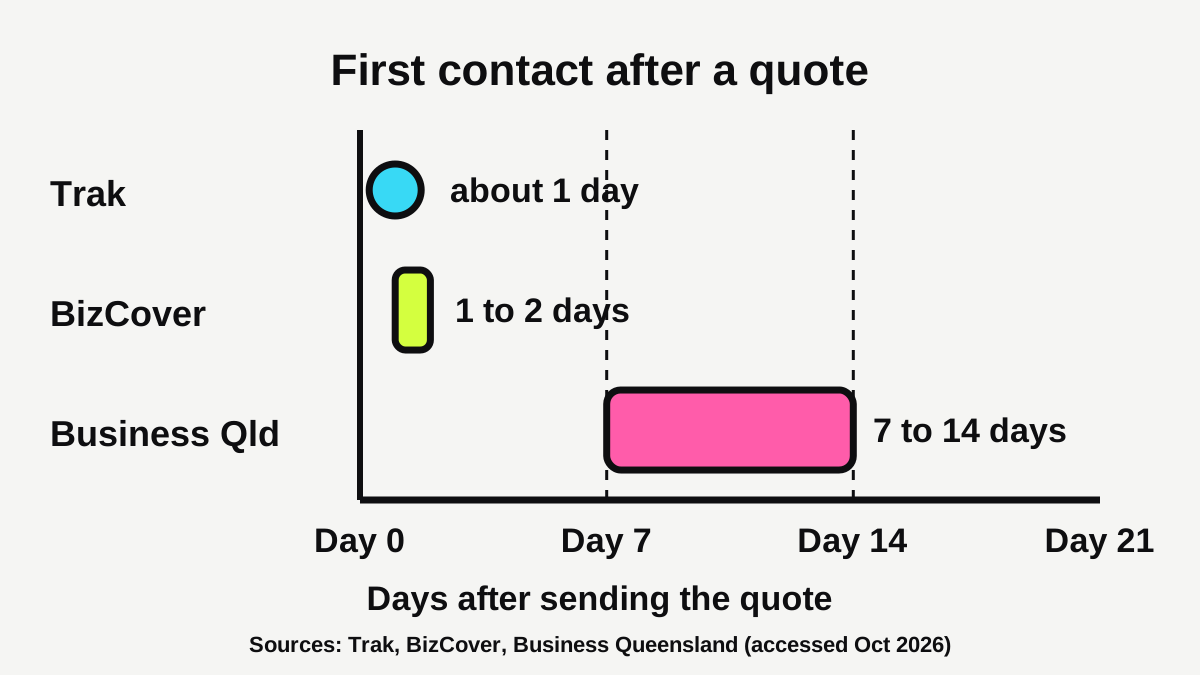
Published advice from Australian sources is similar, though not identical. Here is what three of them say:
| Source | First contact | Next contact |
|---|---|---|
| BizCover (tradie quoting guide) | A polite follow-up 24 or 48 hours after delivering the quote [3] | Wait between four and seven days before following up again [3] |
| Trak (tradie tips) | A friendly message or email after about 24 hours, to check they received it [2] | Wait between 3 and 7 days, then give up to another two weeks before reaching out again [2] |
| Business Queensland | Contact the customer 7 to 14 days after you submit the quote [1] | If unsuccessful, politely ask for feedback [1] |
Why do the sources disagree?
They are answering slightly different questions. The tradie guides describe a quick "did you get it?" nudge, then a proper follow-up. Business Queensland describes the point at which to ask whether the customer has decided [1]. None of these is a law or a tested formula. They are practical rules of thumb, so treat the dates as a sensible range and not a deadline [2][3].
What timing should you pick?
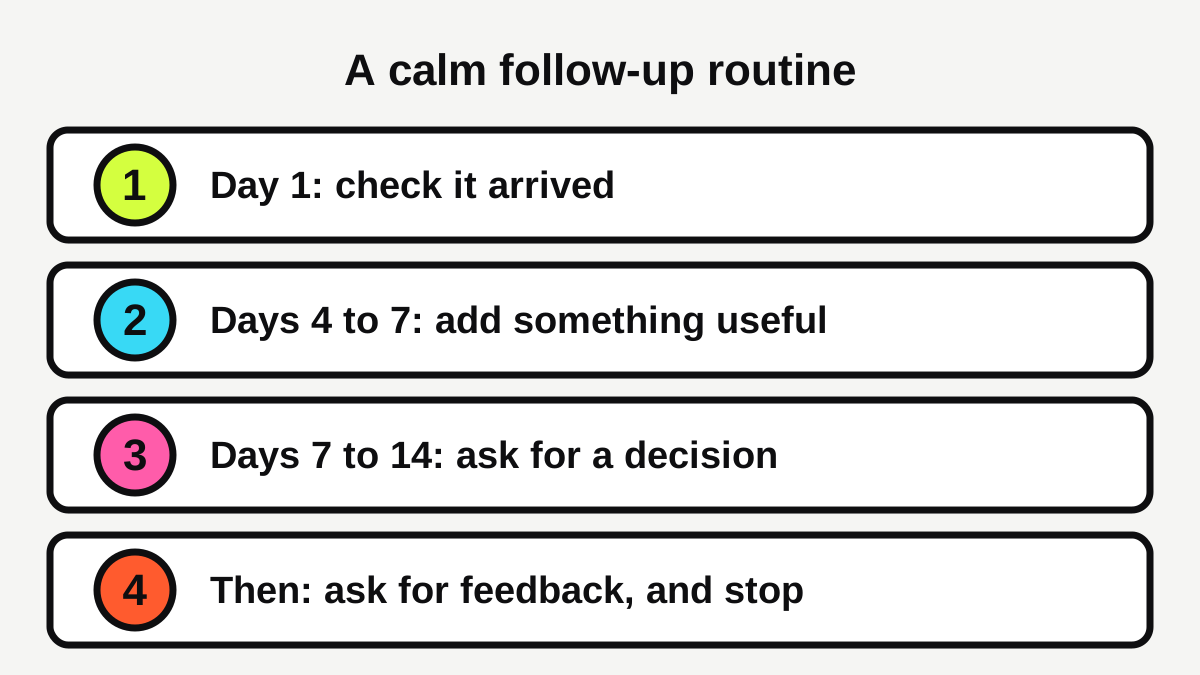
For most local jobs, a rhythm that sits inside all three works well:
- Within 1 to 2 days: check the quote arrived [2][3].
- Around day 4 to 7: send one useful follow-up.
- Around day 7 to 14: ask whether they have decided, and what you can clarify [1].
- Then stop, with a final friendly message and a note on file.
Bigger jobs, such as a renovation, deserve more patience than a quick repair, and Trak itself says to adjust for the size of the job [2]. BizCover warns that following up any sooner than a few days after your reminder "may get on your prospect's nerves" [3].
What makes a follow-up feel pushy?
Pushy is about how the message feels to the person receiving it, not how many messages you sent. These are the common culprits:
- The same message again. "Just checking in" three times says you have nothing to add.
- Pressure with no reason behind it. "Prices go up tomorrow" only works if it is true.
- Contacting people on the wrong channel or at the wrong time. A call during dinner, or a late-night text, undoes goodwill.
- Ignoring a "no" or a "not yet". If someone says they will get back to you, respect it and set your own reminder.
Is there a legal line for chasing?
Yes, though ordinary polite follow-up is nowhere near it. The Australian Consumer Law says you must not use physical force, or undue harassment or coercion, in connection with supplying or paying for goods or services [5]. Consumer Affairs Victoria lists penalties for breaching that rule, which shows it is taken seriously [5]. A reasonable run of friendly messages is nothing like harassment, but it is a good reason to stop when someone says no. This is general information, not legal advice.
What should you say when you follow up a quote?
A good follow-up gives the customer something: an answer, an option or a clear next step. Keep it short and use their name and their job.
The first check, a day or two later
The goal is simply to confirm that the quote arrived and that nothing is unclear. Trak's advice is a friendly message to check they have received it, which can also prompt a faster decision [2].
Hi Jess, it's Sam from Sam's Plumbing. Just checking the quote for the bathroom tap and vanity landed OK. Happy to answer any questions.
The useful follow-up, a few days after that
Add something new. It might be a question, a photo of similar work, a note on when you have a gap in the diary or how long you can hold the price.
Hi Jess, a quick one on the bathroom job. I can fit it in the week of the 4th if you'd like to lock it in. The quote is valid until the 28th. Is there anything you'd like me to adjust?
Mentioning an expiry date is only honest if your quote has one. Business Queensland recommends putting an expiry date on every quote, because material costs and supplies can rise quickly and "without an expiry date, you may have to honour a quote that will lose you money" [1].
The decision check, a week or two on
Ask a simple, open question, and make "no" easy to say. Business Queensland suggests asking whether the customer has questions or has decided on your quote [1].
Hi Jess, I'm tidying up my quotes for the month. Have you had a chance to decide on the bathroom job? Either way is fine, I'd just like to know so I can plan the diary.
The last message
If the customer is silent after your final message, Trak suggests leaving a voicemail if a call goes unanswered, letting the client come back to you and keeping their details and notes in case they get in touch later [2]. If they say no, Business Queensland suggests politely asking what you could improve [1].
No problem at all, Jess. If you have a minute, I'd value knowing what swayed your decision. And my details are here if anything changes.
Phone, text or email: which works best?
BizCover suggests following up by phone or text because emails are easier to miss [3]. In practice, use the channel the customer used to contact you, then try another if there is no reply.
| Channel | Good for | Watch out for |
|---|---|---|
| Text | Quick "did you get it?" checks | Needs to feel personal, not like a mass message |
| Phone | Bigger jobs and questions | Easy to miss, so leave a short voicemail [2] |
| Sending the quote with detail and an expiry date | Easier to miss, so do not rely on it alone [3] |
Do you need consent to send follow-up texts and emails?
Possibly. business.gov.au says that you must have a person's permission before you send them electronic messages that offer, advertise or promote your business, goods or services [4]. That permission can be express, where the person knows and accepts they will receive messages, or inferred, where it is reasonable to believe they would expect them [4]. Messages must include clear, easy unsubscribe instructions, and you must remove people no later than 5 working days after they ask [4].
The page does not say whether a reply to a quote someone asked for counts as promotion, so we cannot answer that for you. A sensible approach is to keep follow-ups relevant to the quote they requested, include a simple way to opt out in anything automated and ask your software provider or an adviser if you are unsure. We cover related rules for automatic replies in our guide to missed call text back.
How do you make your quote easy to say yes to?
Many follow-ups only exist because the quote itself left questions unanswered. Business Queensland lists what a quote should include: business details with your ABN, a quote date, number and expiry date, itemised costs showing GST, any variations and options, payment terms, a timeline and a place for the customer to accept [1].
Is a quote different from an estimate?
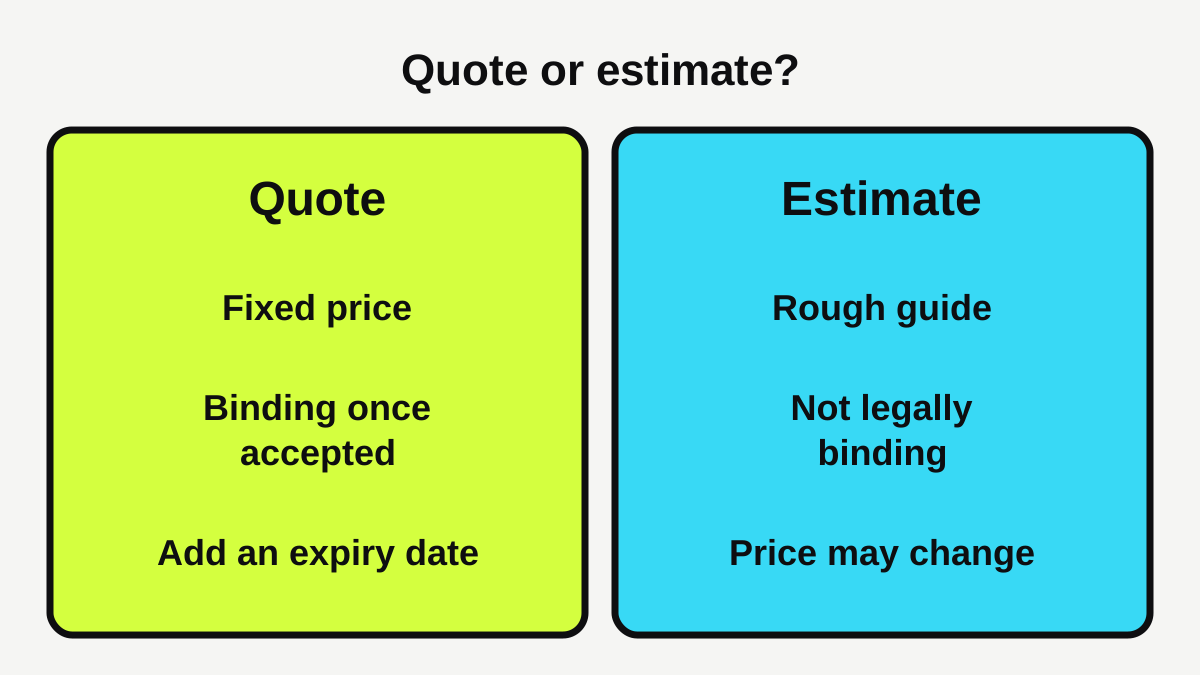
Yes, and customers often mix them up. According to Business Queensland, an estimate is a rough cost guide made without full specifications, it is not legally binding and usually carries a disclaimer that the price may change [1]. A quote is different: once the customer accepts it, it "forms part of a legally binding contract" [1]. So follow up with the right word. If the document is a quote, mention the expiry date. If it is an estimate, say what would firm it up, such as a site visit.
What should you do once they say yes?
Get a signature or written confirmation before starting work or ordering materials [1]. A reply of "yes please" by text is a good start, and a clear written acceptance of the quote protects both of you. Our guide to what pages a tradie website needs shows how a clear process on your site, such as how quoting works, can also answer questions before they are asked.
What if the customer says it is too expensive, or goes silent?
Silence and "too expensive" both look like rejection, but they usually mean something more specific.
- "Too expensive": Ask what they had in mind and what matters most. Offer to change the scope, the materials or the timing before you change the price. If it will not work at their budget, say so kindly.
- "I'll think about it": Ask what would help them decide, and agree on when you will check in.
- Silence: Send your last message, then pause. Keep their details so you can come back with something real, such as a gap in your schedule.
- A "no" with a reason: Say thanks and ask one question about how to do better [1].
A fast, professional first reply helps all of these. A Zoho survey reported by IT Brief Australia found that 72% of Australians expect an answer from a business within an hour (22% instantly, 37% within 30 minutes and 13% in 30 to 60 minutes), although the report does not give the sample size [6]. People who feel looked after at the start are more likely to answer your later messages.
How do you stay on top of quotes without it taking over your week?
The real reason follow-up fails is not nerves. It is that you are on the tools and the quote slips your mind. A tiny system fixes that.
- Keep one list. Date sent, customer, job, amount, next follow-up date and outcome.
- Set a reminder on the day you send each quote. Trak suggests setting reminders in your phone or job management software, and removing them if the client contacts you first [2].
- Write your three messages once and save them as templates you tweak with the name and the job.
- Record notes from every conversation, so you do not repeat yourself or sound like you do not care [2].
- Review monthly. Count quotes sent and jobs won. If you win very few, the problem might be price, scope or how clear the quote is, not follow-up.
This is one of the jobs that suits a simple automation, such as an automatic reminder or a first nudge text. If your day is full of site visits, our automations service can set up reminders and templated messages for you, though you can do the whole thing with a spreadsheet and your phone. If the quotes you are chasing came from your website, our free website scan shows whether your site makes it easy to ask in the first place.
Does this apply to every trade and business?
The rhythm is the same, but the pace changes. A plumber or electrician quoting a repair might follow up within a day or two, while a builder quoting a large job should expect a longer decision, and fewer, more considered messages. Whichever it is, ask the customer on the first call how soon they want to decide. Then you are following their timeline, not guessing.
What to do next
- Add an expiry date to your quote template [1].
- Put your ABN, itemised costs, payment terms and a place to accept on every quote [1].
- Set a reminder for 1 to 2 days after sending each quote [2][3].
- Write three short follow-up messages: a check, a useful nudge and a final decision check.
- Pick one channel for the first check, and try phone or text if emails get no answer [3].
- Keep a simple list of quotes sent, followed up and won, and review it monthly (see when a small business needs a CRM if the list outgrows a spreadsheet).
Following up on a quote is just good service: you are making sure a person you want to help has what they need to decide. Do it politely, do it with something useful to say and let the answer be yes or no.
Hand the admin to an AI employee.
Custom automations for the jobs that eat your week, quoted before we start.
Sources
- [1]Preparing a business quote · Business Queensland (Queensland Government) · accessed 18 October 2026
- [2]Tradie Tips: Following Up on Quotes · Trak · accessed 18 October 2026
- [3]How to quote a job - Tips for tradies to win more contracts · BizCover · accessed 18 October 2026
- [4]Promoting your business by email or text messages · business.gov.au (Australian Government) · accessed 18 October 2026
- [5]Penalties - unfair practices · Consumer Affairs Victoria (Victorian Government) · accessed 18 October 2026
- [6]Zoho study reveals rising customer service expectations in Australia · IT Brief Australia · accessed 18 October 2026