Lead response time: how fast should you reply?
Aim to reply to a new lead within minutes, and within the hour at the latest. What the research says, what Australians expect and a simple routine to follow.
By the Omniwink team · 17 October 2026 · 10 min read
Listen to the summary· 2 min

How fast should you reply to a new lead? As fast as you reasonably can: minutes if possible, and within the hour at the latest. If you can't give a personal reply that quickly, send an automatic one straight away that confirms you have the message and says when a real person will respond.
That is the short answer, and it matters because most people sending an enquiry are comparing a few businesses at once. This guide explains what we know about lead response time, what Australians say they expect, which numbers to trust (and which to be careful with), and a simple routine a busy owner can keep.
Why does lead response time matter for a small business?
A lead is anyone who has just asked you for something: a quote request through your website, a message on Facebook, a missed call, a booking form. At that moment they have a problem and they are paying attention. An hour later they may have chosen someone else, or forgotten why they asked.
Two things make speed matter more for a local business than for a big company:
- Customers often ask more than one business. The first one to reply looks organised and keen. The last one may never get a look in.
- You have fewer enquiries to spare. A large company can lose a hundred leads and barely notice. If you lose three in a week, that may be a real chunk of your income.
Speed is not the only thing that wins work. Price, reviews, trust and quality all count. But speed is one of the few parts you control completely, and it costs nothing to improve. It also depends on your website making it easy to ask in the first place, which we cover in our guide to what makes a local business website get enquiries.
What do Australians expect, and what does the research say?
How quickly do Australians expect a reply?
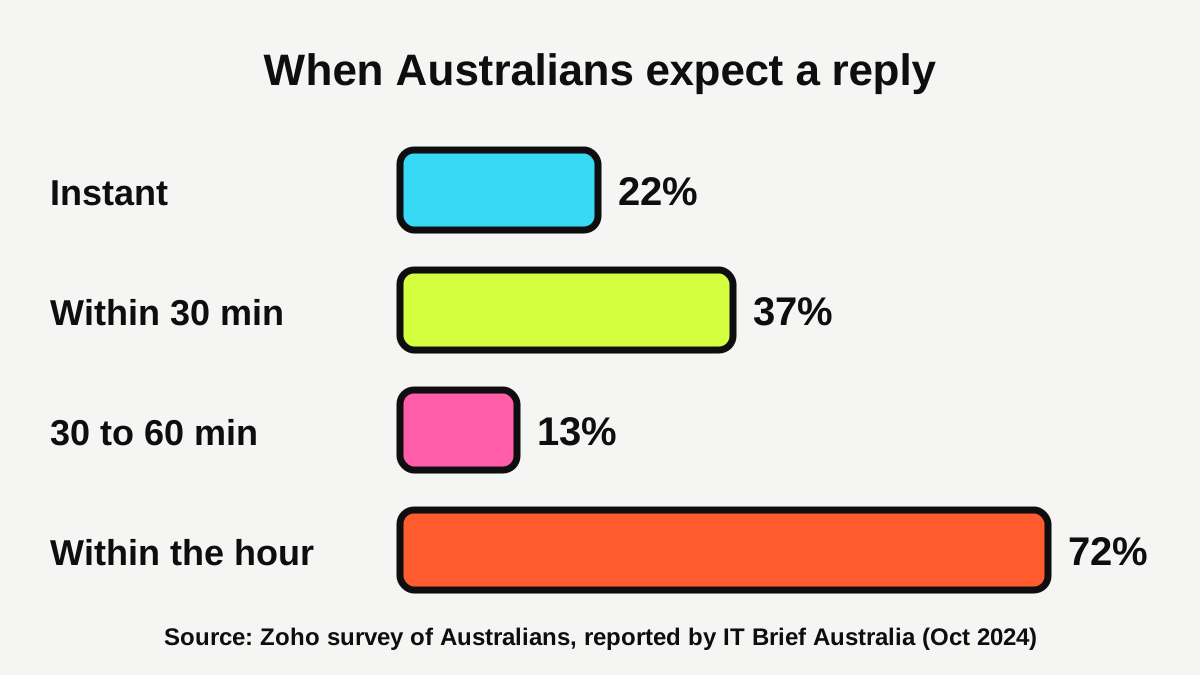
A survey by Zoho, reported by IT Brief Australia in October 2024, found that 22% of Australians expect an instant response from a business, 37% expect a reply within 30 minutes and 13% within 30 to 60 minutes [4]. Together that is 72% who expect an answer within an hour [4]. The article does not say how many people were surveyed or when, and it describes general customer expectations that "extend to small businesses", so use it as a guide to attitudes and not a precise count [4].
What happens to your odds as the minutes pass?
The best-known research on reply speed is a study by InsideSales.com with Professor James Oldroyd of MIT. It examined three years of data from six companies, covering over 15,000 web-generated leads and over 100,000 call attempts [1]. It asked when companies should call web leads for the best chance of making contact and of "qualifying" the lead, which in some cases meant the lead agreed to an appointment [1]. Its main findings:
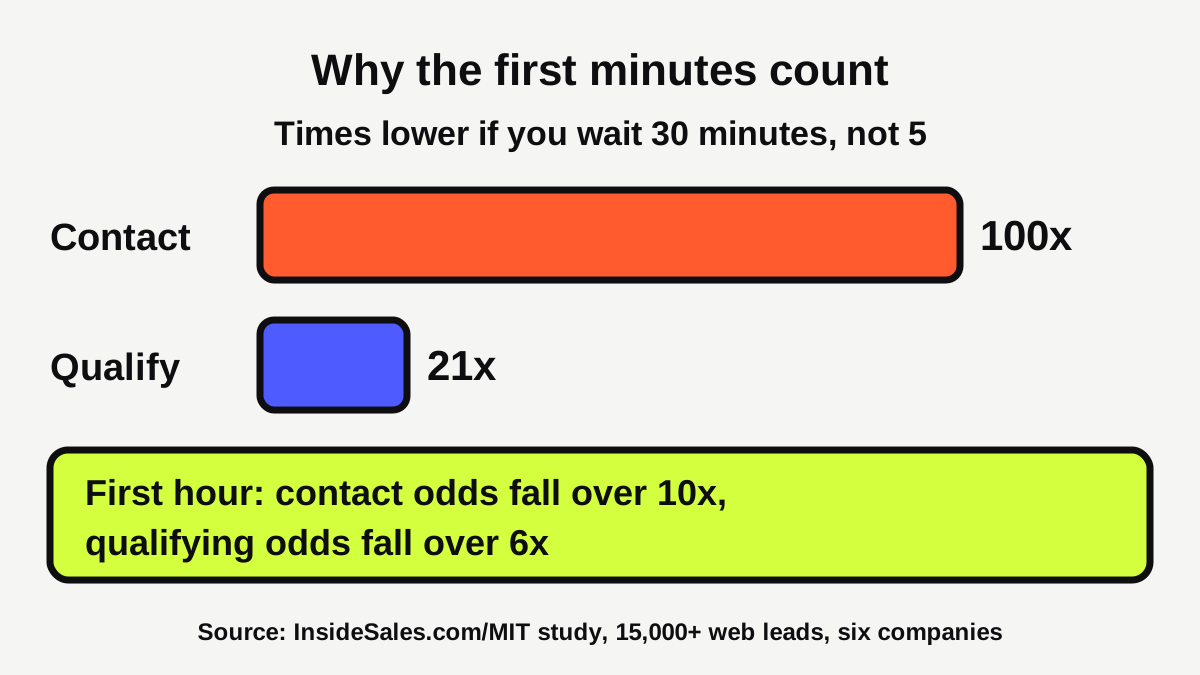
- The odds of contacting a lead drop by over 10 times in the first hour, and the odds of qualifying a lead drop by over 6 times [1].
- The odds of contacting a lead called within 5 minutes versus 30 minutes drop by 100 times, and the odds of qualifying it drop by 21 times [1].
- Even from 5 minutes to 10 minutes, the odds of contact fall by about 5 times [1].
Which of those numbers should you trust?
Be careful. The data came from InsideSales.com's own system, and the study was presented in 2007 [1]. It measured calls to web leads, not completed sales: the study itself says it "did not address close ratios" [1]. The companies were not small local trades, and the figures describe odds of reaching a person, not how much work a quick reply wins you.
So do not promise yourself a "21 times" jump in sales. The honest reading is the direction: the longer you wait, the harder the lead is to reach, and the biggest drop comes in the first hour [1].
Do businesses actually reply quickly?
Often not. In a Harvard Business Review study, researchers sent a test enquiry to 2,241 US companies [3]. Only 37% replied within an hour, 24% took more than 24 hours and 23% never replied at all [3]. Among those that did reply within 30 days, the average wait was 42 hours [3]. The authors concluded that most companies "are not responding nearly fast enough" [2]. That study is from 2011 and covers US firms and web enquiries, so it shows a pattern and not an Australian rate [2][3]. The pattern is the useful part: a fast reply can set you apart because slow ones are common.
What is a good response time for a local business?
There is no official Australian benchmark for small businesses, so treat the table below as a sensible target built from the evidence above, not a rule. Pick the row that fits how you work and then keep to it.
| Reply type | Target | Why |
|---|---|---|
| Automatic acknowledgement | Within minutes, any hour | Tells the person you have their message, which most people want to know |
| Personal reply in business hours | Within 1 hour, sooner if you can | The first hour is where the odds fall hardest [1], and 72% expect a reply inside an hour [4] |
| Personal reply after hours | By a stated time next business day | Honest and keepable, which beats a vague "soon" |
| Detailed quote | Within 1 to 2 working days, once you have a first conversation | The first reply wins attention, the quote wins the job |
For comparison, even the Australian Government's business.gov.au aims to respond to phone, email and social media enquiries within one working day [6]. That is the standard for a government help service, so for a business competing for work, an hour is a fair target and one working day is the outer edge.
Is an automatic reply as good as a personal one?
Not quite, but it is far better than silence. An automatic reply confirms the message arrived and buys you time. It should be followed by a real person. We explain the phone version in our guide to missed call text back, and the same idea works for forms and messages.
How do you actually reply faster?
Most slow replies happen for ordinary reasons: you are on a job, the notification went to an email inbox you check at night, or you meant to reply later. Fix the system and the speed follows.
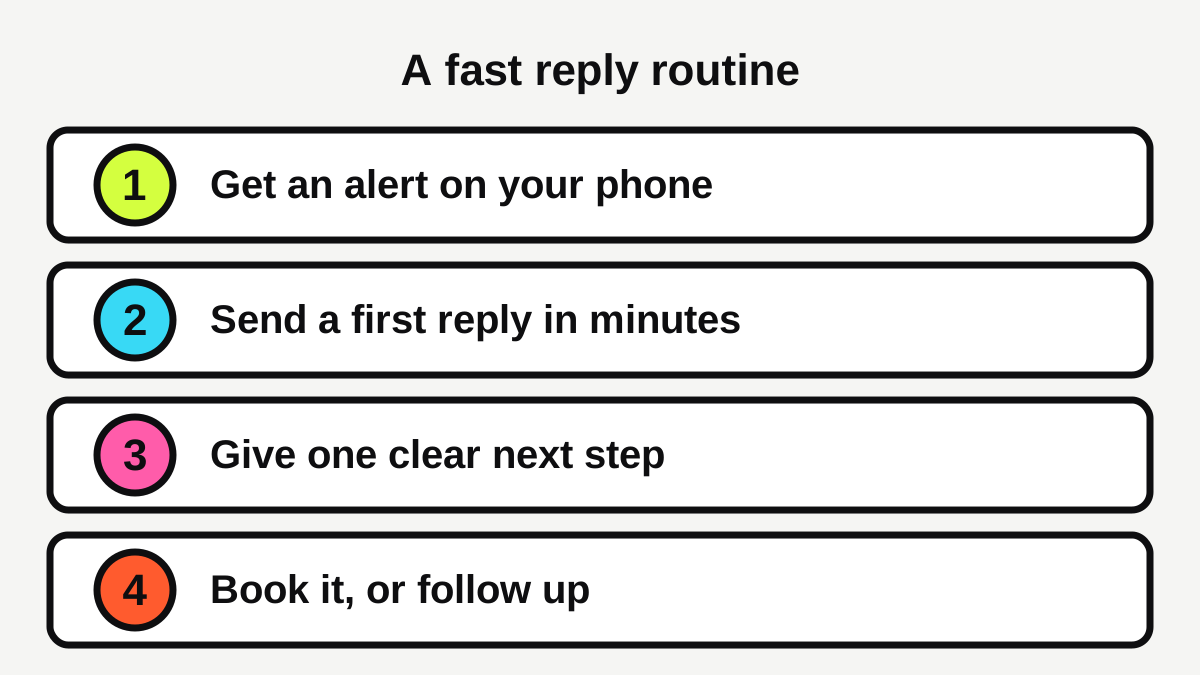
- Get an alert on your phone. Make sure website forms, Facebook messages and missed calls all ping the device in your pocket, not an inbox you check once a day.
- Prepare a short reply template. Three or four sentences: who you are, what you will do next, and one question that moves things along ("What suburb are you in, and when do you need it?").
- Reply with a human tone. Use the person's name and refer to what they asked. A first reply does not need a full quote.
- Offer one clear next step. A time to call, a booking link or a photo request. Too many options slow the person down.
- Share the load. If you are on the tools all day, ask a partner, an office person or an automation to send the first reply.
What should the first reply say?
Keep it to what the person needs right now. For example: "Hi Jess, it's Sam from Sam's Plumbing. Thanks for getting in touch about the leaking tap. Could you send a photo and your suburb? I'll call you between 3 and 4pm today." It names the person and the problem, asks for one thing and gives a time you can keep. Once you have sent a quote, our guide on how to follow up a quote without being pushy covers what to do next.
What are the rules for automatic texts and emails?
If an automatic message could count as marketing, business.gov.au says you need the person's consent, either express (they know and accept they will receive messages) or inferred (they gave you their details and would reasonably expect to hear from you) [5]. Make unsubscribing clear and free, remove people within 5 working days of a request, and keep the unsubscribe option working for at least 30 days after sending [5]. If your texts show a business name rather than a number, they must be registered on the SMS Sender ID Register or they may be labelled "Unverified" [5]. This is general information, not legal advice. Ask your provider if you are unsure.
Does speed matter for every kind of lead?
It matters most when the customer wants something done soon and is comparing a few options. That covers plumbers, electricians, cleaners, salons and many clinics. It matters less for a long, considered decision, where being helpful and reliable counts for more than being first.
A fast reply cannot fix a poor fit either. If the person is outside your area or wants something you don't do, a quick, polite "sorry, we can't help, here's who might" is still a good reply, and it keeps your time free.
When can you slow down?
- Late at night: an automatic reply and a clear time next morning is enough.
- Complex jobs: reply quickly to say you've got it, then take the time you need to quote properly.
- When you are already booked solid: say so, and offer a date. An honest "next available is the 28th" beats silence.
How do you check your own response time?
You don't need software to find out, though our guide to whether a small business needs a CRM explains when a proper customer list starts to help. Do this once a fortnight:
- List your last 10 enquiries from forms, messages and calls.
- Write down when each arrived and when you first replied.
- Note which ones took longest, and why (on a job, after hours, no alert).
- Fix the cause, not the person: an alert, a template or a handover.
If a lot of replies take more than a day, treat it as a bigger issue than any other marketing task. There is no point paying for more enquiries if the ones you have go cold. You can also run a free website scan to check whether your site makes it easy for people to reach you in the first place.
What to do next
- Decide your rule: an automatic reply in minutes and a personal reply within the hour in business hours.
- Turn on phone alerts for forms, messages and missed calls.
- Write one short reply template and save it on your phone.
- Set up an after-hours auto-reply that names a time you will keep.
- Check your last 10 enquiries and see how long you really took.
- If the first reply is the hard part, ask about our automations service, which can send it for you in seconds.
Replying quickly is not a trick. It is a way of showing a stranger that you are reliable, and it is one of the cheapest improvements a local business can make.
Hand the admin to an AI employee.
Custom automations for the jobs that eat your week, quoted before we start.
Sources
- [1]The InsideSales.com/MIT Lead Response Management Study · InsideSales.com (summary hosted by Mortech) · accessed 17 October 2026
- [2]The Short Life of Online Sales Leads · Harvard Business Review (via Brigham Young University ScholarsArchive) · accessed 17 October 2026
- [3]Are you letting online leads go cold? · SmartCompany · accessed 17 October 2026
- [4]Zoho study reveals rising customer service expectations in Australia · IT Brief Australia · accessed 17 October 2026
- [5]Promoting your business by email or text messages · business.gov.au (Australian Government) · accessed 17 October 2026
- [6]Customer service charter · business.gov.au (Australian Government) · accessed 17 October 2026