Missed call text back: what it is and is it worth it?
Missed call text back sends an instant SMS when you can't answer. How it works in Australia, the rules to follow, what to write and when it's worth it.
By the Omniwink team · 16 October 2026 · 8 min read
Listen to the summary· 2 min

When you can't answer the phone, missed call text back sends the caller a text message within seconds. It says sorry, says who you are, and gives them an easy next step, such as replying with what they need or tapping a link to book. The aim is simple: a caller who would have tried the next business on Google hears from you first.
It is worth it if you regularly miss calls while your hands are busy and a new customer is worth a few hundred dollars or more. It is not worth much if you rarely miss a call. This guide explains how it works, what to write, the Australian rules to know about, and how to tell whether it is paying for itself.
What is missed call text back, and how does it work?
Missed call text back is a small piece of automation. When a call to your business number goes unanswered, the system notices and sends an SMS to the caller's mobile. You don't have to touch anything.
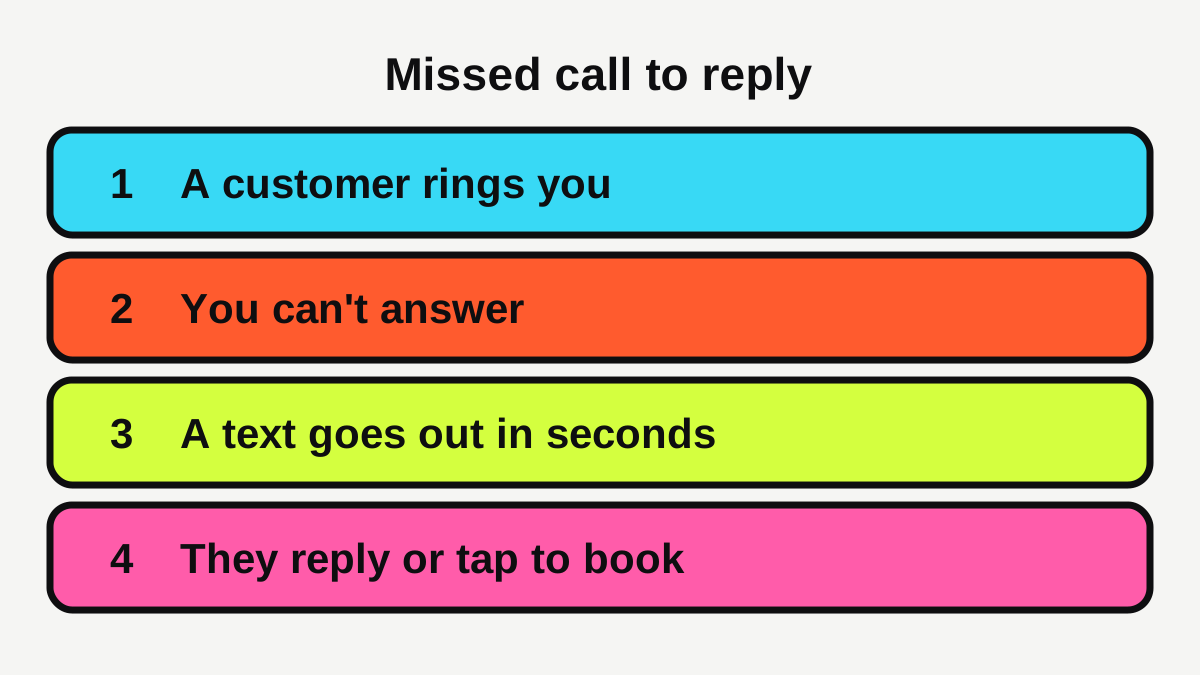
Most setups follow the same pattern:
- A customer rings your business number.
- The call rings out, goes busy or is diverted because you can't take it.
- The service detects the unanswered call and sends a short text from your number or business name.
- The customer replies, taps a link or waits for your call back.
How do the calls reach the service?
In many cases you keep your usual number and set your phone to divert calls it does not answer. Telstra's help page lists the standard codes for this: 61 for no answer, 62 for unreachable and 67 for busy, with a default of 15 seconds of ringing before a divert, adjustable between 15 and 30 seconds in 5-second steps [5]. Telstra also says call forwarding is included in all plans with unlimited call allowance [5]. Other providers have their own settings, so check what yours charges for forwarded calls before you turn anything on.
Is it the same as voicemail?
No. Voicemail makes the customer do the work: leave a message, hope you listen to it, wait. A text turns the missed call into a conversation they can continue on the phone already in their hand. You can still keep voicemail as well.
Why does a quick reply matter to local customers?
People who ring a local business usually have a problem to fix or a booking to make. They are often ringing two or three businesses at once.
An Australian survey run by Zoho and reported by IT Brief found that 22% of Australians expect an instant response from small businesses, 37% expect a reply within 30 minutes, and 13% expect one within 30 to 60 minutes [4]. That adds up to 72% who expect an answer inside an hour. The article does not state the sample size, and the report is from 2024, so treat it as a guide to expectations and not an exact count [4].
Harvard Business Review researchers tested how businesses handle web enquiries [1]. In a test of 2,241 US companies, 37% replied within an hour, 16% took between one and 24 hours, 24% took more than 24 hours, and 23% never replied at all [2]. Among companies that did reply within 30 days, the average wait was 42 hours [2].
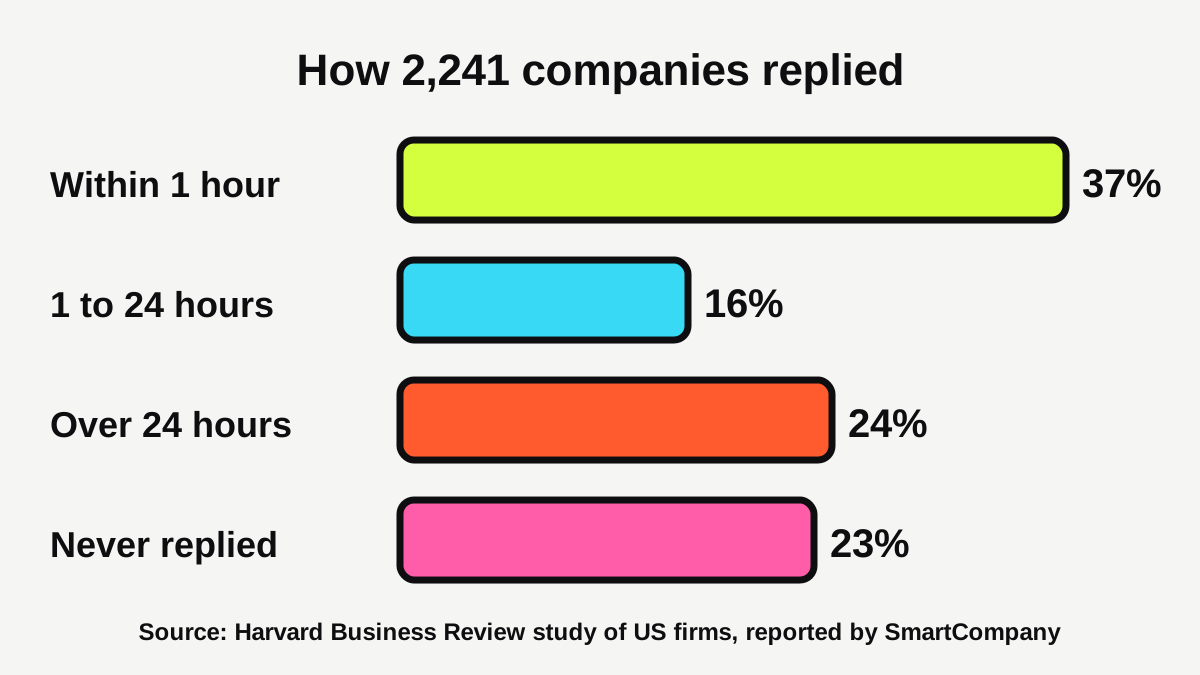
Be careful with that study. It is from 2011, it covered online enquiries and not phone calls, and the companies were in the United States [1][2]. It does not prove that a text will win you a job. What it shows is that slow or missing replies are common, so being quick is a real way to stand out.
We cover reply speed more broadly in our guide to what makes a local business website get enquiries, because the same habit applies to forms and emails, and our guide to how fast to reply to a new lead sets out a simple target for every kind of enquiry.
Who is missed call text back worth it for?
It helps most when three things are true:
- You miss calls for good reasons. You are on a roof, under a sink, mid-cut, with a patient or driving.
- A new customer is worth real money, so one rescued job covers the cost.
- Callers are likely to try a competitor if they hear nothing.
| Business | Why calls get missed | Good first message |
|---|---|---|
| Plumbers and electricians | Hands full on a job | "Is it urgent? Reply with your suburb and the problem." |
| Cleaners | Working in a client's home | "Reply with your suburb and the number of bedrooms for a quote." |
| Salons | Mid-appointment | "Tap here to book online, or reply with a day that suits." |
| Physios and dentists | Front desk busy or closed | "Our booking link is below. We'll call back when we open." |
When is it not worth it?
If you almost never miss a call, you will pay for something you rarely use. If your main problem is that the calls you get are the wrong ones, a text won't fix that. And if nobody follows up the replies, you have only made a promise you can't keep. A text works only if a person (you or someone on your team) then picks up the conversation.
What are the rules in Australia?
An automatic text is still a text, so it is worth knowing the rules before you set it up. This is general information, not legal advice. If you are unsure, ask your provider or a lawyer.
The Spam Act 2003 has sections that say unsolicited commercial electronic messages must not be sent, that messages must include accurate sender information, and that they must contain a functional unsubscribe facility [6]. Whether a particular reply to someone who just rang you counts as a commercial message is a question for your adviser, so the safe habit is to follow the same good practice anyway.
Business.gov.au sets out what that looks like [3]:
- Get permission. It recognises two types: express consent, where the person knows and accepts they will receive messages from you, and inferred consent, where they gave you their details and could reasonably expect to hear from you [3].
- For express consent, keep a record of who gave permission, when and how [3].
- Give a clear way to opt out, remove people within 5 working days of a request, charge no fee, and keep the opt-out working for at least 30 days after each message [3].
- Don't require extra personal information or an account login to opt out [3].
Do branded sender names need registering?
Business.gov.au says businesses that send branded text messages (SMS and MMS) must be registered on the SMS Sender ID Register, and that unregistered sender IDs may be labelled "Unverified" by telcos and message providers [3]. If your text shows your business name instead of a phone number, ask your provider whether it has been registered. If texts come from a normal mobile number, this may not apply, but confirm that with them.
Keep it to one useful message
The safest design is one short reply to a person who has just called you, about the thing they called about. Don't add them to a marketing list unless they agree to it. The ACMA enforces these rules and can investigate complaints and take action, including fining a business [3].
What should the text say?
Keep it short, human and useful. A good message does four jobs.
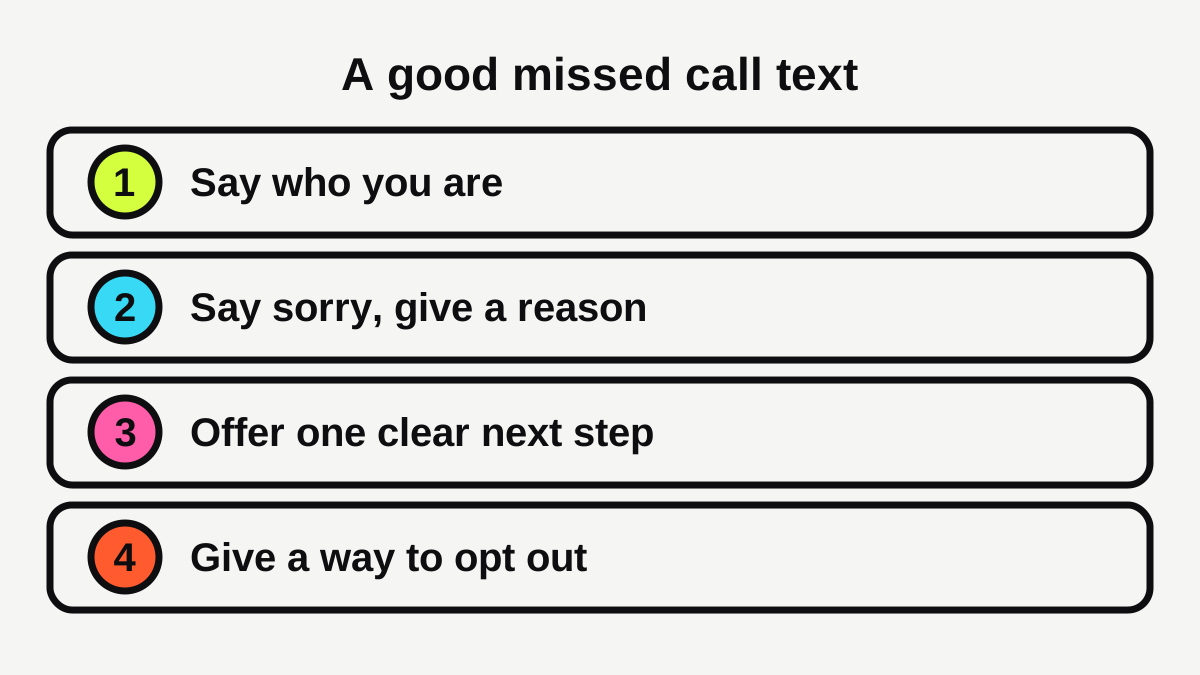
- Say who you are. The caller may not have saved your number.
- Say sorry and give a reason. "Sorry we missed you, we're on a job."
- Offer one clear next step. A question they can reply to, or one link to book.
- Give a way to opt out. Ask your provider how it handles replies like "STOP", as business.gov.au says opting out must be simple and free [3].
Here is an example for a tradie: "Hi, it's Sam from Sam's Plumbing. Sorry we missed your call, we're on a job. Is it urgent? Reply with your suburb and the problem and we'll get back to you today. Reply STOP to opt out."
What mistakes should you avoid?
- Sending three texts for one missed call.
- Promising a call back time you won't meet.
- Using the text to sell something unrelated.
- Forgetting to test it, so it fires at the wrong time or from the wrong number.
- Leaving it on while you are in the office, so callers get a text right after you've spoken.
How do you know it's paying for itself?
Work with numbers you already have.
Count your missed calls
Look at your phone's call log for a typical week. Count missed calls from numbers you don't know. That's your pool of lost chances.
Work out what a customer is worth
If an average job is worth a few hundred dollars, rescuing one extra job a month may cover a service fee. Ask providers for the full price, including messages and any set-up cost, before you decide. Our website cost calculator shows the same kind of thinking for other costs.
Track replies for a month
Keep a simple tally: texts sent, replies received, jobs booked. After a month you will know whether it is bringing in work. Ask new customers how they found you, and note when they say "you texted me back".
What to do next
- Count the calls you missed last week.
- Check your phone plan's call forwarding settings and charges [5].
- Decide on one message and one next step, such as a booking link or one question.
- Ask any provider about opt-out handling and sender ID registration [3].
- Test it by ringing your own number from another phone.
- Review after a month: texts sent, replies, jobs won.
If you'd like help setting up replies like this, see our automations service. You can also run a free website scan to check the other ways customers find you.
Hand the admin to an AI employee.
Custom automations for the jobs that eat your week, quoted before we start.
Sources
- [1]The Short Life of Online Sales Leads · Harvard Business Review (via Brigham Young University ScholarsArchive) · accessed 16 October 2026
- [2]Are you letting online leads go cold? · SmartCompany · accessed 16 October 2026
- [3]Promoting your business by email or text messages · business.gov.au (Australian Government) · accessed 16 October 2026
- [4]Zoho study reveals rising customer service expectations in Australia · IT Brief Australia · accessed 16 October 2026
- [5]How do I forward calls on my mobile? · Telstra · accessed 16 October 2026
- [6]Spam Act 2003 (table of contents) · Federal Register of Legislation (Australian Government) · accessed 16 October 2026