How often should a small business post on social media?
Aim for 3 to 5 Instagram posts and 3 or more Facebook posts a week, then adjust. How often to post on social media for a small business, and how to keep it up.
By the Omniwink team · 28 October 2026 · 8 min read
Listen to the summary· 2 min

For most small businesses, a good starting point is three to five Instagram posts a week and about one Facebook post a day, or at least a few a week if daily is too much. Buffer's guide gives those same figures: one to two posts a day for a Facebook Page, and three to five a week on Instagram [1].
Then adjust. The best number is the one you can keep up. Buffer says the right frequency is one you can maintain, and that consistent posting beats perfect volume [1]. Shopify's guide agrees that consistency matters more than volume, and says that if you can only manage three posts a week, keep to three [2].
This guide covers what the research says about how often to post on social media, how Australian small businesses actually do it, and how to build a routine that doesn't burn you out.
How often should a small business post on Facebook?
Buffer cites a HubSpot study of more than 13,500 Facebook users that found one to two posts a day is the ideal frequency for a Facebook Page [1]. That figure does not apply to Facebook Groups [1].
That number is a benchmark from marketing vendors, not a platform rule, and it assumes you have something worth posting every day. Business Queensland says to post each day when you are growing your profile, but adds that each platform has a preferred frequency and you should post no more than that [3].
If daily posting is unrealistic, a lower rhythm you keep is better than a daily one you drop after a fortnight. A tradie with a few good job photos a week, or a cafe with a daily special, can both manage a steady stream. A clinic or accountant with less to show may do better with two or three considered posts a week.
How often should you post on Instagram for business?
Aim to post in your feed at least three to five times a week [2]. Buffer's range is the same, and it counts Reels in that figure rather than giving them a separate target [1].
Stories are different. Shopify says at least once a day is a good rule of thumb, but admits there is less consensus on that [2]. Stories do not significantly increase your reach, because they are mainly seen by people who already follow you, but they help keep your audience engaged [2].
Does posting more actually help?
Mostly yes, with a catch. Buffer's analysis of Instagram median reach per post found that accounts posting three to five times a week got about 12 percent more reach per post than those posting once or twice. Six to nine posts a week got about 18 percent more, and ten or more got about 24 percent more [1]. Follower growth followed the same pattern: +0.12 percent for one to two posts a week, +0.26 percent for three to five, +0.44 percent for six to nine and +0.66 percent for ten or more [1].
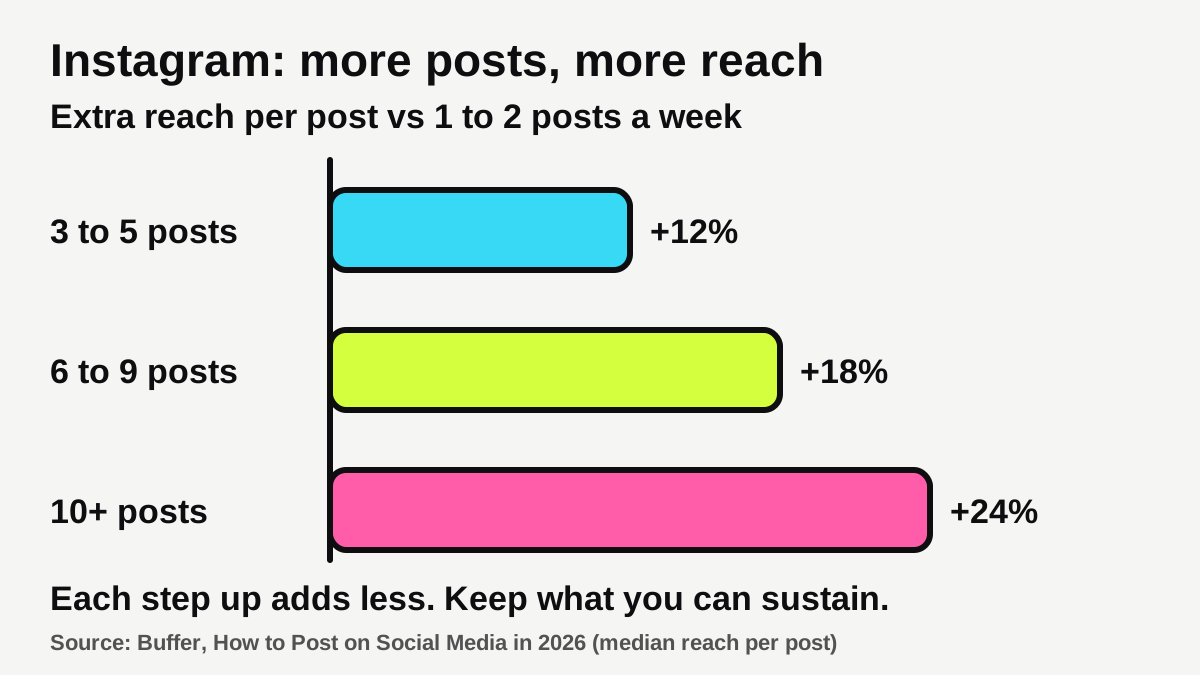
Notice the shape: each step up needs a lot more work for a smaller gain. Buffer says returns diminish with each step [1], and Shopify says the same [2]. Buffer's article does not state the sample size or dates for this analysis [1], so use it as a guide to direction, not a promise.
Shopify also notes that posting twice a day can help, but only if you are posting interesting content [2].
How often do other Australian small businesses post?
Fewer than you might think. The Yellow Social Media Report 2018 (the most recent business edition we could read in full) found that among small businesses with a social media presence, 19 percent updated every day, 28 percent a few times a week, 24 percent once a week and 14 percent once a month. A further 8 percent updated a few times a month and 6 percent a few times a year, and 3 percent never [4].
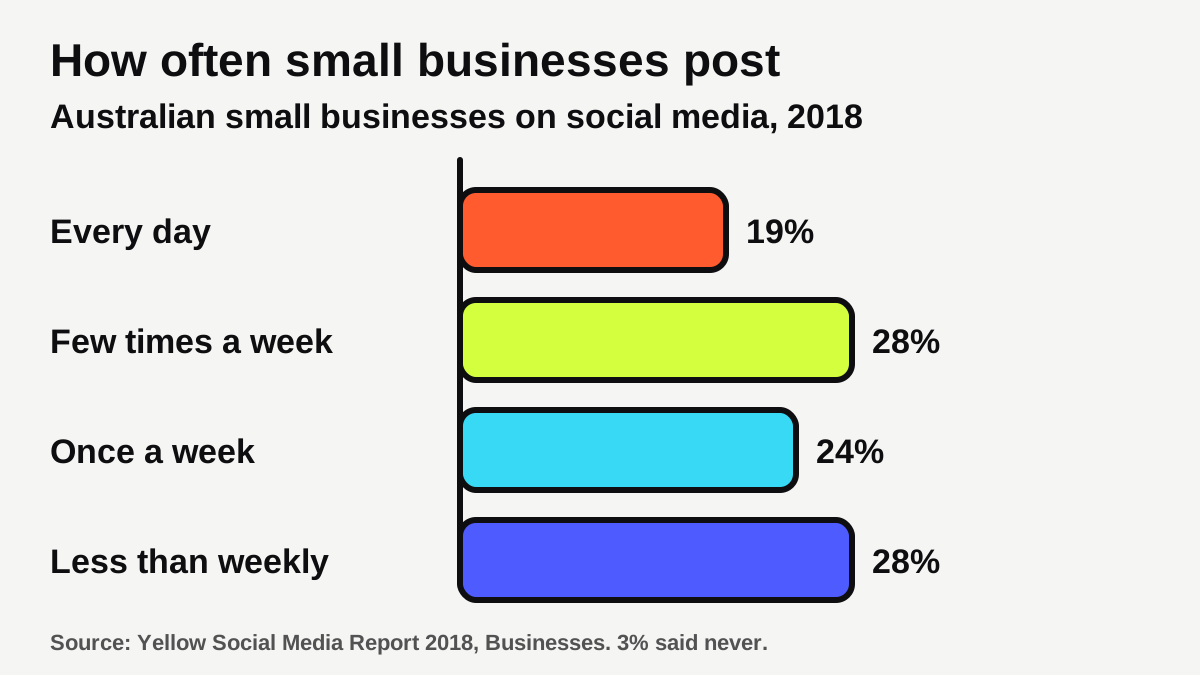
The report says most small and medium businesses spread the task out over a week rather than posting daily [4]. It is an older survey, and platforms have changed a lot since, so read it as a snapshot of habits, not a target. Still, it shows that you do not need to post daily to be in the pack, and that many businesses struggle to keep up. In the same report, the main reason businesses that had left social media gave was that it took too much time to manage [4].
| Platform | Benchmark to start with | Source |
|---|---|---|
| Facebook Page | 1 to 2 posts a day, or a steady few a week if that is more realistic | [1][3] |
| Instagram feed (including Reels) | 3 to 5 posts a week | [1][2] |
| Instagram Stories | Once a day if you can, but optional | [2] |
Is it better to post every day or less often?
Quality and consistency win. Buffer's FAQ says quality content always wins over just volume [1], and its research on more than 100,000 users found regular posting meant five times more engagement, although it does not give the study dates [1].
That does not mean "post less". It means a half-hearted daily post is worth less than a well-made post three times a week. A few signs that you are over-posting:
- You are reusing the same photo or message just to hit the number.
- Your posts are getting thinner and you dread the daily task.
- You are skipping replies to comments because you are busy posting.
On that last point, Business Queensland says to respond to comments as quickly as possible, even with an automated reply that gives your contact details [3]. A fast reply to a customer is worth more than an extra post. If posts bring in enquiries, our guide to how fast to reply to new leads explains why speed matters.
How do you build a posting routine you can keep?
Think smaller than you would like, then scale up once it feels easy.
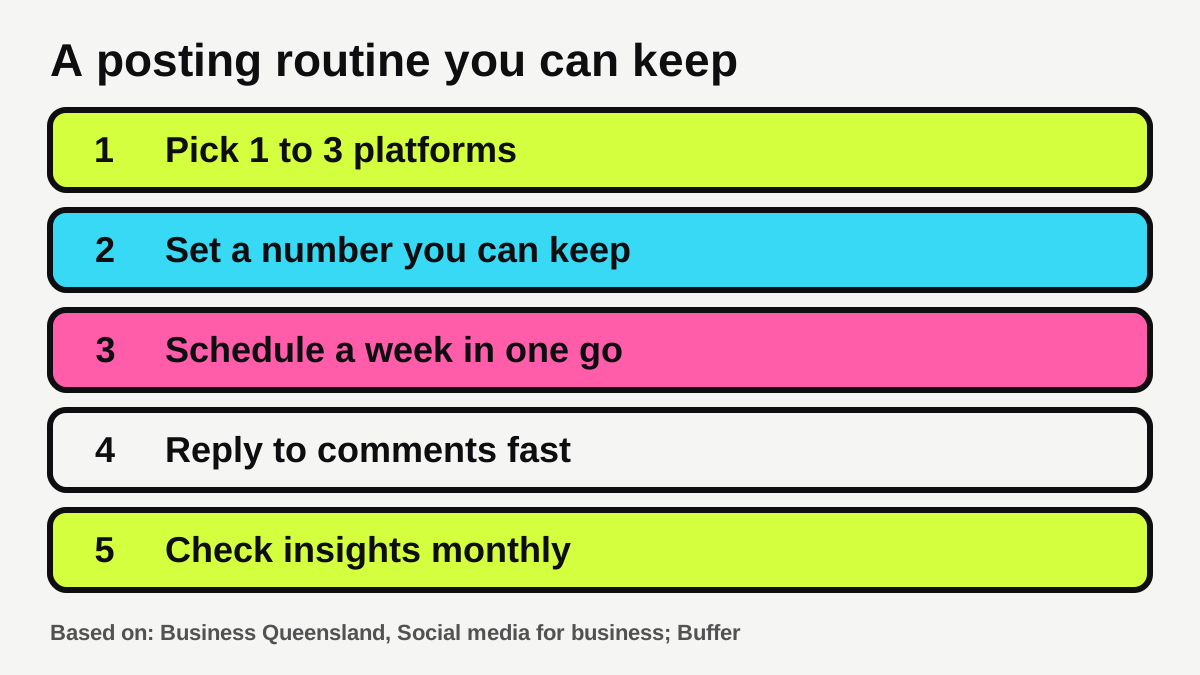
1. Pick one to three platforms
Business Queensland suggests choosing one to three platforms to focus on rather than spreading yourself thin, based on your business type, audience and goals [3]. For most local businesses that means Facebook and Instagram, or just one of them. Our guide to what social media management costs shows how the number of platforms drives the price if you ever outsource.
2. Set a number you can keep
Start with a target you can hit in your busiest month. If three posts a week is all you can do, keep to three [2]. You can lift it later.
3. Plan and schedule a week at a time
Business Queensland recommends a social media strategy with a timeline for scheduling posts, and a content calendar that maps out what you will post and where [3]. Meta Business Suite is free to use, and lets you schedule posts across Facebook and Instagram, with a Planner tab that shows a calendar of what is scheduled [5].
If you are short of ideas, our free social post ideas tool suggests posts for your type of business. Shopify's advice is to repurpose your best-performing posts and to tell the same story in different formats [2], so one job, one product or one customer question can fuel several posts.
4. Reply quickly
Set a time each day to check comments and messages, or turn on an automated reply with your phone number and booking link [3]. Your link in bio page can give people one clear place to book or call.
5. Check what is working, monthly
Business Queensland says to track your results and try a different approach if a tactic is not working [3]. Meta Business Suite includes an Insights tab with analytics on posts and stories, which Buffer says can help you identify the best times to post [5]. Business Queensland also notes that posting when your audience is likely to be online increases impact [3], so look at your own numbers instead of a generic "best time".
What should you post when you have nothing to say?
The posting schedule is the easy part. Ideas are the hard part. Shopify recommends high-quality photos, whether your own or from customers, and using your top-performing posts as a guide to what to share more of [2]. A few ideas that suit local businesses:
- A before and after of a finished job.
- A quick answer to a question customers often ask.
- A behind-the-scenes look at your team or workshop.
- A seasonal reminder (for example, getting your heating checked before winter).
- A customer review or a thank you, with permission.
Health and finance businesses need extra care. Keep posts general and informational, and follow the advertising rules for your profession, for example no promised outcomes and no testimonials about clinical care for health services. This guide is general information only.
What to do next
- Choose one or two platforms where your customers already are.
- Pick a weekly number you can honestly manage: for example three Instagram posts and three Facebook posts.
- Spend one sitting each week writing and scheduling posts in Meta Business Suite [5].
- Reply to comments and messages quickly [3].
- After a month, look at your insights and adjust your rhythm [3][5].
If you would rather not do it yourself, our content service can plan and write posts for you, and you can see how your business looks online today with a free visibility scan. For ideas on what suits your trade, see our pages for salons and cafes.
Want this done for you every weekday?
The Content Engine writes, designs and posts in your voice.
Sources
- [1]How Often to Post on Social Media in 2026: A Data-Backed Guide · Buffer · accessed 28 October 2026
- [2]How Often Should You Post on Instagram? 2026 Guide · Shopify (Australia) · accessed 28 October 2026
- [3]Social media for business · Business Queensland (Queensland Government) · accessed 28 October 2026
- [4]Yellow Social Media Report 2018 - Part Two: Businesses · Yellow (formerly Sensis) · accessed 28 October 2026
- [5]Meta Business Suite: What It Is and How to Use It · Buffer · accessed 28 October 2026