How much does social media management cost in Australia?
Social media management in Australia is free if you do it yourself and about $1,000 to $8,000+ a month with a pro. What each level includes and how to choose.
By the Omniwink team · 27 October 2026 · 9 min read
Listen to the summary· 2 min

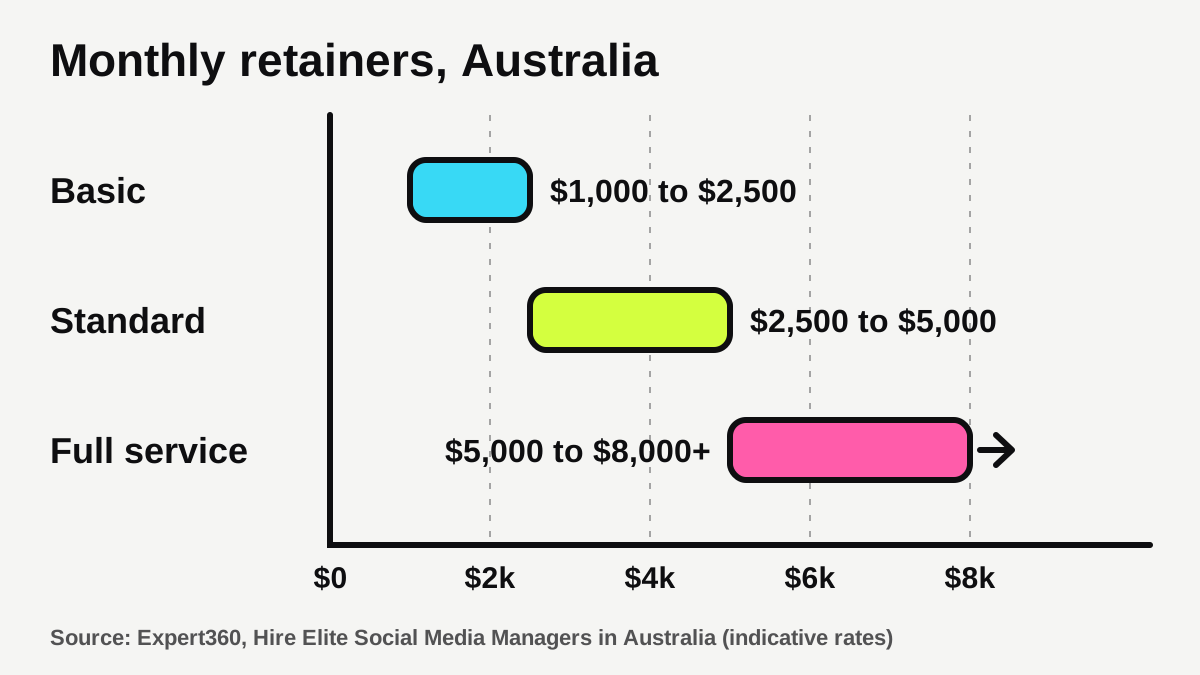
Social media management in Australia costs nothing in cash if you do it yourself, and roughly $1,000 to $8,000 or more a month if you hire a professional. One marketplace lists basic management on one or two platforms at $1,000 to $2,500 a month, a standard service at $2,500 to $5,000, and a full strategic service at $5,000 to $8,000 or more [1].
For most local businesses, the sensible range is the bottom one: a set number of posts on one or two platforms, light replies to comments and messages, and a simple report. That is enough to look active and be easy to contact without paying for a big campaign.
These figures are indicative, not quotes. This guide shows what drives the price, what each option includes, the cheaper routes, and how to decide what to spend.
How much does a social media manager cost in Australia?
It depends on who you hire and how much you ask for. Here are the ranges published by three Australian sources, all in AUD per month.
| Option | Monthly cost | What it usually means |
|---|---|---|
| Do it yourself | $0 plus your time | You plan, write and post; free tools cover scheduling [5] |
| Freelancer or consultant | $500 to $5,000 [2] | One person; quality and reliability vary a lot |
| Offshore or hybrid team | $1,500 to $3,500 [2] | Lower cost, usually execution-heavy work |
| Domestic agency | $2,000 to $10,000 [2] | A team, with strategy and reporting |
| In-house employee | Over $10,000 fully loaded [2] | A full-time hire |
Another provider gives a narrower picture of the middle: freelancers at around $2,800 a month for basic management, agencies at around $3,000 a month as a baseline, and an offshore manager at about $1,450 [3]. That page was first published in 2018 and says its figures come from its own rates and other sources, so use it as a sense check only [3].
Day rates, if you only need a hand
If you need a strategy session or an audit instead of a monthly retainer, the same marketplace puts freelancer day rates at $450 to $1,000, averaging about $530 a day [1]. It also says regulated sectors such as health and finance carry a premium of 20 to 50 percent [1], which is worth knowing if you run a clinic or a broker's office.
Why the ranges are so wide
The sources do not agree with each other, and one even gives two different ranges for domestic agencies [2]. That is normal. Social media is not a standard product, so two quotes for "managing our Instagram" can describe very different work.
What changes the price?
When you compare quotes, look for these differences first.
- Number of platforms. The Queensland Government suggests choosing one to three platforms to focus on rather than spreading yourself thin [4]. Each extra platform adds work.
- Posts per week. Three well-made posts cost less than daily posting. The government advice is to post regularly while you grow your profile [4], but regularly is not the same as daily for every business.
- Video. Short-form video takes more planning, filming and editing than a photo with a caption. The marketplace's mid tier explicitly includes content creation [1].
- Community management. Replying to comments and messages is real work. The Queensland Government says to respond as quickly as possible, even with an automated reply that gives contact details [4].
- Paid ads. Ad management is usually a separate fee, and the ad spend itself is extra. The Queensland Government describes paid options as usually low-cost [4], but the budget is your decision.
- Reporting and strategy. The top tier in the marketplace listing includes strategy and paid social [1]. A basic tier includes light reporting only.
What do you get at each price level?
Basic: $1,000 to $2,500 a month
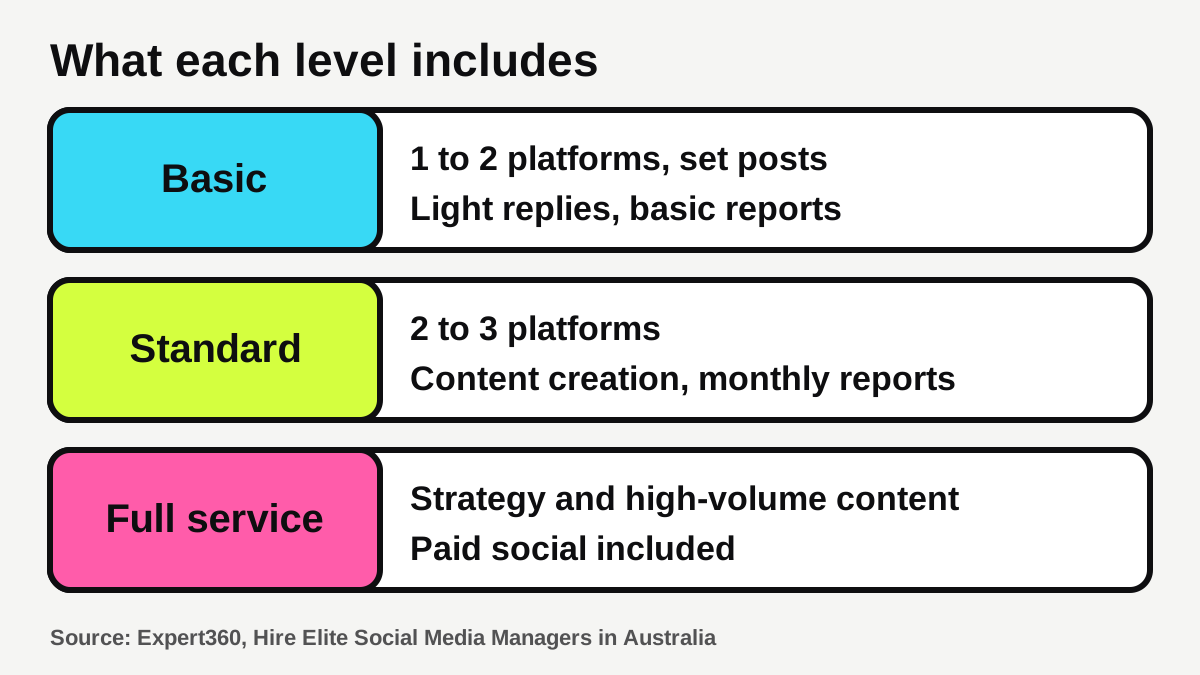
One or two platforms, a set number of posts, light community management and basic reporting [1]. This suits a tradie, a salon or a clinic that wants a steady, professional presence without a big program.
Standard: $2,500 to $5,000 a month
Two or three platforms with content creation and monthly reporting [1]. This suits a business with a team, a lot to show off (a cafe, a gym, a real estate office) or a campaign to push.
Full service: $5,000 to $8,000 or more a month
Strategy, high-volume content and paid social [1]. Most small businesses do not need this unless social media is a core sales channel.
Is a freelancer, an agency or an offshore team better?
Each has trade-offs.
A freelancer is often the best fit for a small local business. You deal with one person who learns your business. The risk is reliability: if they get busy or leave, your posting stops. Ask for samples, a written scope and a notice period.
An agency costs more but brings a team: a strategist, a designer, someone to reply to comments. It suits larger businesses or ones with several locations [2].
An offshore or hybrid team costs less because much of the work is execution, and one provider claims savings of up to 75 percent on labour costs [3]. The trade-off is local knowledge: suburbs, slang, seasons and Australian advertising and privacy rules are easier to get right with someone who lives here. Business Queensland notes that businesses must follow privacy legislation and the laws on spam and copyright [4].
An in-house hire rarely makes sense for a small business. One Australian source puts a local social media manager's salary at $80,000 to $100,000 a year, and says the real cost passes $120,000 once super, leave, tax and tools are added [2].
If you are weighing up where to put your marketing money, see our guide to how much a small business website costs in Australia, since the two budgets often compete.
Can you do it yourself for free?
Yes, and for many small businesses it is a good place to start. The Queensland Government says many forms of social media are free for business [4]. Meta Business Suite is free to use, lets you manage Facebook and Instagram in one place, and lets you schedule posts and Reels and Stories on a Planner calendar [5].
The cost is your time, so set a routine you can keep:
- Pick one or two platforms where your customers already are [4].
- Plan a month at a time with a simple content calendar [4].
- Schedule posts in one sitting instead of posting live each day [5].
- Reply to comments and messages quickly [4].
- Check results once a month using the platform's built-in analytics [4].
If you are stuck for ideas, our free social post ideas tool suggests posts for your type of business, and our link in bio page builder gives your profile one clean page that sends people to your booking or phone number.
A middle path works well too: do the posting yourself, and pay for a few hours of help to set up a plan, photograph your work and write a month of captions. Day rates for this kind of project work are in the range above [1].
What costs do people forget to budget for?
The monthly fee is rarely the whole bill. Ask about these before you agree.
- Ad spend. If you want paid posts, the money paid to the platform is separate from the manager's fee. Decide a monthly cap in writing.
- Photos and video. A manager can only post what they are given. Fresh photos of your team, your work and your premises make posts far better than stock images, and a half-day shoot every few months is often money well spent.
- Your time. Even a full-service provider needs you to approve posts, share news and answer questions about jobs, prices and availability. Budget an hour or so a week.
- Tools. Some agencies pass on the cost of scheduling or design software. Ask whether it is included in the retainer.
- Setup. Some providers charge a one-off fee to audit your accounts and plan the first month.
- Out-of-hours enquiries. If posts bring in messages, someone has to answer them promptly. If that is you, factor in the time. Our guide to how fast to reply to a new lead explains why speed matters.
What are the warning signs of a poor deal?
Be careful if a provider:
- guarantees followers, viral posts or a set number of sales;
- will not tell you exactly what is included each month;
- wants a long contract with no way out;
- keeps the logins or the accounts in their own name;
- shows no recent work for local businesses like yours;
- sells you a big package before asking what you want social media to achieve.
Good providers ask about your customers, your busy and quiet seasons and how you handle enquiries before they quote.
How do you choose a provider and avoid wasting money?
Before you sign, work through this list.
- Decide the goal first. "More enquiries from local families" is a better brief than "more followers".
- Ask exactly what is included each month: platforms, number of posts, video, replies, reporting and any ad management.
- Ask who owns the accounts. The pages and logins should stay in your business's name.
- Get quotes for the same job from two or three providers so you are comparing like with like.
- Ask to see work for similar local businesses, and check their own pages are active.
- Start with a three month trial and agree simple measures: enquiries, messages and calls, not just likes.
- Check the notice period so you can stop if it is not working.
You can see how this plays out for a specific trade on our pages for cafes and salons.
What to do next
- Write down what you want social media to do for the business in one sentence.
- Choose one or two platforms and set up a free Meta Business Suite calendar [5].
- Run a month yourself to see what takes the time.
- If it is too much, collect two or three written quotes for the same scope and compare them against the ranges above [1][2].
- Review after three months using enquiries, not likes.
If you would rather have posts planned and written for you, our content service covers it. To see how your business looks online today before you spend anything, run a free visibility scan.
Want this done for you every weekday?
The Content Engine writes, designs and posts in your voice.
Sources
- [1]Hire Elite Social Media Managers in Australia - Vetted Shortlist in 48 Hours · Expert360 · accessed 27 October 2026
- [2]Outsource Social Media Management in Australia: Costs, Risks, and What Actually Works · Penbrothers · accessed 27 October 2026
- [3]The Whats, Whys, and Hows of Social Media Marketing for SMEs · Kinetic Innovative Staffing Services (KIS) · accessed 27 October 2026
- [4]Social media for business · Business Queensland (Queensland Government) · accessed 27 October 2026
- [5]Meta Business Suite: What It Is and How to Use It · Buffer · accessed 27 October 2026