Advertising rules for small business in Australia
The Australian advertising rules a small business needs to know: honest claims, total prices, reviews, emails and texts, and health ads, in plain English.
By the Omniwink team · 13 November 2026 · 8 min read
Listen to the summary· 2 min

The main advertising rule in Australia is that what you say and show must be true and must not leave customers with a false impression. That covers your website, social posts, flyers, quotes and emails, and it applies to a one-person business as much as a big one. This guide sets out the advertising rules for a small business in plain English: honest claims, showing the right price, specials, reviews, emails and texts, and health ads.
None of this should stop you advertising. Most small businesses already do the right thing. The goal is to know where the lines are, so a quick check before you hit publish is enough. This is general information, not legal advice, and rules differ a little by state and industry.
What is the main advertising rule?
It is the Australian Consumer Law ban on misleading or deceptive conduct. The NSW Government says it is against the law for businesses to engage in misleading or deceptive conduct, or to make false or misleading representations about goods or services [1]. Claims that create a false impression about price, value or quality are caught. Intent to mislead is not required, and nobody has to have lost money [1].
Consumer Affairs Victoria puts it in a way that is worth remembering: a business can mislead and deceive without intending to [2]. The question is the overall impression your marketing creates, not what you meant [2].
Does it apply to everything I publish?
Yes. The rule covers advertisements, promotions, quotations, statements and any representation [2]. A caption on Instagram, a line on your Google Business Profile and a verbal promise on the phone are all part of your advertising.
What claims can you make, and which are risky?
Honest, specific claims are fine. Risky ones are those you can't back up. The ACL prohibits false or misleading representations about matters such as quality, price, availability of repairs, place of origin and shipping times [3].
A few practical points:
- Puffery is allowed. Wildly exaggerated, fanciful or vague claims that no reasonable person would take seriously are not treated as misleading [1]. "The best coffee you'll ever taste" is a feeling. "Voted best in Victoria" needs to be true.
- Predictions need a basis. You can't make promises you know you can't keep, or predictions without a reasonable basis [1]. Saying "we'll be there in an hour" when you can't be is a risk.
- Leaving things out can mislead. Withholding relevant facts known only to the business can be misleading, depending on the circumstances [1][2]. If a price needs a call-out fee, say so.
- Small print has limits. Disclaimers and fine print can't contradict the overall message of an ad, though a prominent disclaimer may be enough to protect a business, depending on the circumstances [1].
Business names are a separate point. A business trading under a name other than the owner's must register it under the Business Names Registration Act 2011, which ASIC administers [3].
How must you show prices?
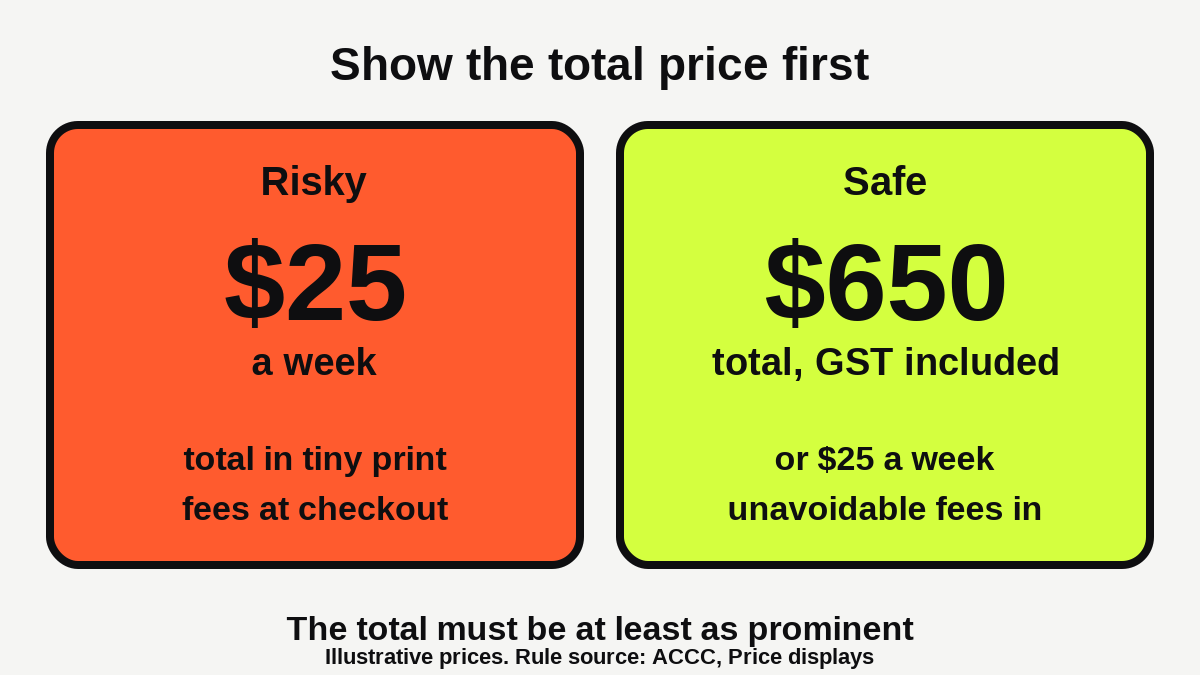
Show one total price. The ACCC says businesses must display the total price of a product or service as a single figure, covering the lowest amount a customer could pay, including taxes and unavoidable or pre-selected extra fees [4]. NSW Fair Trading adds that stating only part of the price without the total, including GST, is an offence [3].
Optional extras that are not pre-selected don't need to be in the total [4]. If you also show a partial price, such as a weekly or monthly amount, the total must be at least as prominent [4].
What is drip pricing?
Drip pricing is when a price is advertised at the start of an online purchase and extra fees are added gradually during checkout [4]. The ACCC says businesses must disclose the types of fees and when they apply at the start of the purchase process [4]. If you take online bookings or deposits, check that your booking page matches your advertised price. Our guide to what makes a local business website get enquiries covers how to make this clear on the page.
What if I show more than one price?
If more than one price is shown for an item, you must either sell at the lowest price or stop selling until the price is corrected [4]. Selling above the lowest marked price is an offence [3]. Check your website, your window sign and your social posts agree.
What about specials, discounts and limited stock?
Two rules matter here, both from NSW Fair Trading:
- Inflating a price to make something look discounted or on sale is an offence [3].
- Advertising goods you have reasonable grounds to believe you can't supply for a reasonable period is "bait advertising". Plan for demand, and if stock is limited, say so and make the offer period clear [3].
The NSW Government also notes that rebates, prizes and free items must be provided within the specified time, or within a reasonable time if none is given [1]. And you can't accept payment without intending to supply, or without being able to supply in a timely way, unless a genuine failure was beyond your control and you took due diligence [1].
A simple habit helps: write down what a "sale" price was before the sale, and keep it.
Can you use reviews and testimonials in your ads?
Yes, if they are real. Business.gov.au says it is illegal to create or arrange for a fake or misleading review [5]. A review can be fake or misleading if it:
- is written by someone who hasn't used the product or service;
- is altered or removed by you or someone else after posting;
- comes from your family, employees or paid people without disclosing the connection [5].
Offering an incentive is acceptable only if it is offered for both positive and negative reviews, and you clearly disclose it [5]. We cover this in detail in can you offer a discount for a review in Australia, and in how to get more Google reviews. Our free Google review link tool makes asking easy.
Do health businesses have extra rules?
Yes, and they are strict. Under the National Law, testimonials and purported testimonials can't be used to advertise regulated health services [7]. A testimonial is a positive statement about the clinical aspects of a service, such as a patient story about a result [7]. Comments about customer service or communication style, without clinical aspects, are not testimonials and may be used [7].
Ahpra also says that if a social media page promotes a regulated health service it is advertising, and that editing reviews to remove negative comments can be misleading [7]. If you run a dental or physio practice, see our guide on using AI in a regulated business too.
What are the rules for email and text marketing?
You need permission, a clear way out, and a quick response when someone leaves. Business.gov.au sets out the basics for commercial messages [6]:
| Rule | What it means |
|---|---|
| Permission | Express (they agreed) or inferred (they gave you their email and would reasonably expect marketing) [6] |
| Records | Keep a record of who agreed, when and how [6] |
| Unsubscribe | Clear, easy to see, with no fee and no login needed [6] |
| Speed | Remove people within 5 working days of a request [6] |
| Working period | Keep the unsubscribe option working for at least 30 days after sending [6] |
| Sender ID | Branded SMS senders must register on the SMS Sender ID Register, or messages are labelled "Unverified" [6] |
Customers can report breaches to the ACMA, which can investigate and take action such as issuing a fine [6]. The simplest approach is to add people to your list only when they ask, and to put an unsubscribe line in every message. If you automate follow-ups, check the rules are built in. See our guide on automating admin jobs for how that works.
What happens if you get it wrong?
The penalties can be serious. For misleading conduct, the NSW Government lists a maximum of $2.5 million per offence for individuals [1]. For corporations it is the greater of $50 million, three times the benefit gained (if the court can work it out), or 30 per cent of adjusted turnover during the breach period [1]. Remedies under the ACL for misleading conduct are civil, such as injunctions, damages and compensation orders [2].
In reality, most small businesses are dealt with by being asked to fix the ad. But the cost of a complaint, a refund or a bad review is real, so it pays to get it right at the start.
What to do next
Run through this list once, then again whenever you change your offers:
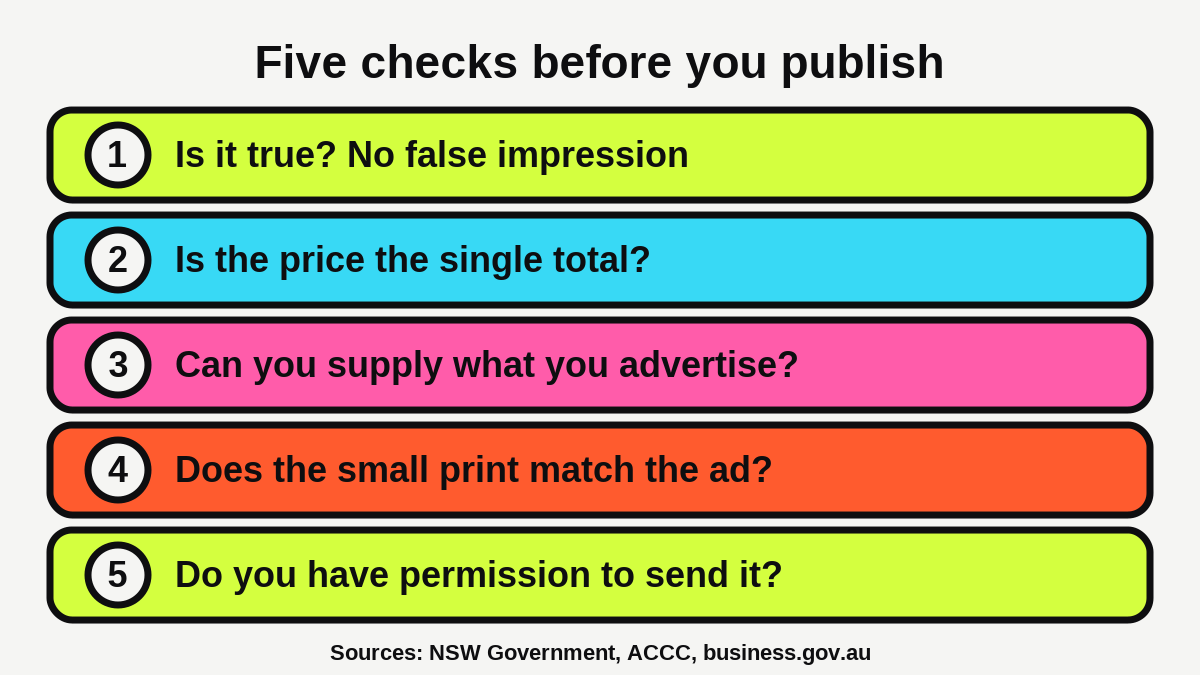
- Read your own website and ads as a stranger. Is anything vague, or likely to leave the wrong impression?
- Check every price. Is the total shown, including GST and unavoidable fees? Is any part price smaller than the total?
- Check specials. Was the "was" price real? Do you have enough stock? Is the end date clear?
- Check your reviews. Don't edit, delete or write them. Disclose any incentive, and offer it for good and bad reviews.
- Check your lists. Do you have a record of permission? Does every message have an unsubscribe link, and do you action requests within 5 working days?
- If you are in health, remove anything that describes clinical results or patient stories.
- If unsure, ring your state fair trading or consumer affairs office, or a lawyer.
If you'd like a second pair of eyes on your website and Google profile, the free Omniwink scan is a quick place to start, and our content service can help keep your posts consistent and clear. Our website cost calculator can also help you plan updates.
Want this done for you every weekday?
The Content Engine writes, designs and posts in your voice.
Sources
- [1]Misleading or deceptive conduct · NSW Government · accessed 13 November 2026
- [2]Misleading or deceptive conduct · Consumer Affairs Victoria · accessed 13 November 2026
- [3]Advertising laws and your business · NSW Government (NSW Fair Trading) · accessed 13 November 2026
- [4]Price displays · ACCC (Australian Competition and Consumer Commission) · accessed 13 November 2026
- [5]Online reviews · business.gov.au (Australian Government) · accessed 13 November 2026
- [6]Promoting your business by email or text messages · business.gov.au (Australian Government) · accessed 13 November 2026
- [7]Testimonials: Understand the requirements · Ahpra (Australian Health Practitioner Regulation Agency) · accessed 13 November 2026