What is a customer worth? Lifetime value for small business
How to work out customer lifetime value for your small business in Australia: a simple formula, two worked examples and what to spend to win a customer.
By the Omniwink team · 12 November 2026 · 9 min read
Listen to the summary· 2 min

A customer's lifetime value is the total a typical customer is worth to your business across the whole time they buy from you. For a cafe it might be a couple of thousand dollars of coffee. For a plumber it might be a few jobs and a referral or two over eight years. Once you have your number, you can answer a question most owners just guess at: how much is it worth spending to win one more customer?
Australia Post gives the simple formula: the average value of a purchase, times how often a customer buys, times the average lifespan of a customer [1]. This guide shows you how to work it out in about ten minutes, why you should use profit rather than sales, and how to compare the result with what you spend on marketing.
What is customer lifetime value, in plain words?
It is the money a customer brings in from their first purchase to their last. Australia Post's example is a candle business: a customer buys a $31 candle every month for a year, so the value is $31 x 12 x 1 = $372 [1]. The same page shows how far the number can stretch in a business-to-business setting. An accounting firm that orders 30 hampers at $250 each, twice a year, for eight years comes to $120,000 [1].
You will see it called CLV, LTV or customer value. They mean the same thing. The point is to stop thinking about one sale at a time and start thinking about the relationship.
That shift matters for local businesses because most of what you spend on marketing is the cost of winning the first job. If a customer only ever gives you one job, that cost is hard to recover. If they come back, or send a friend, the same dollar goes much further. Business Queensland describes the retention stage as keeping a connection with customers to support future purchases and encourage positive word-of-mouth referrals [7].
How do you calculate customer lifetime value?
Use three numbers you probably already know roughly, then adjust for profit.
- Average value of a purchase. Total sales divided by the number of orders or jobs. GoCardless defines average order value exactly this way, as total sales revenue divided by the total number of orders [2].
- How often they buy. GoCardless defines purchase frequency as total orders divided by the number of unique customers [2]. If you sold 2,000 orders to 400 customers, that is 5 orders each [2].
- How long they stay. Australia Post uses the average lifespan of a customer [1]. If you are not sure, look at your customer list and see how many years your regulars have been coming.
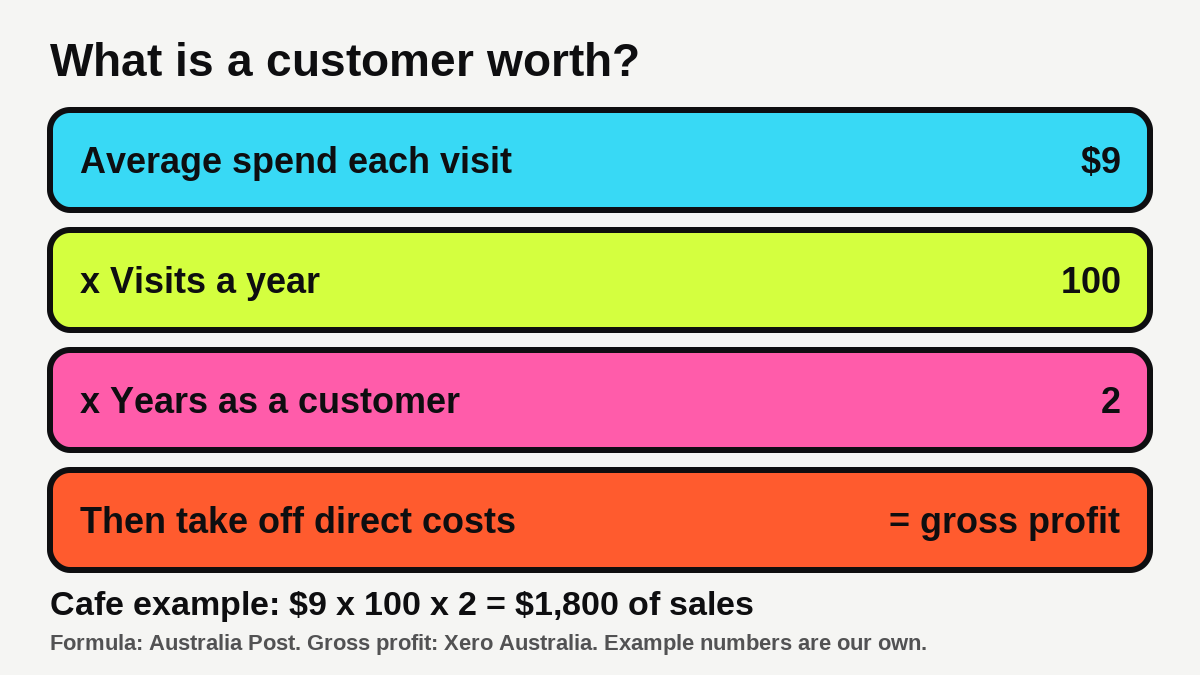
Multiply the three together [1]. That is your revenue per customer over their lifetime.
Why should you use gross profit, not sales?
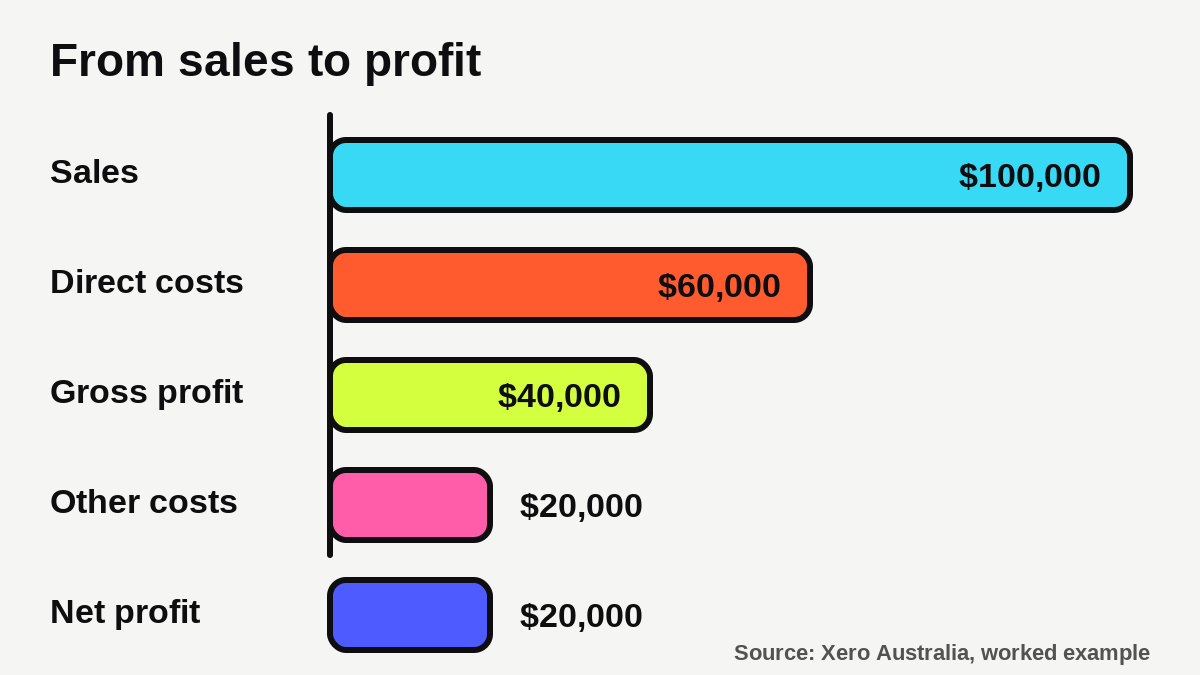
Because you do not keep the sales. Xero defines gross profit as revenue minus the direct costs of producing what you sell. In its example, $100,000 of revenue less $60,000 of direct costs leaves $40,000 gross profit, a 40% gross margin [5]. Net profit goes further and takes off all expenses such as rent, marketing and salaries. In the same example, $20,000 of general expenses leaves $20,000 net profit [5].
GoCardless builds the margin into its fuller formula: average order value x purchase frequency x gross margin x customer lifetime period [2]. For most small businesses, the easy route is to work out the revenue version first and then multiply by your gross margin. Your accountant or bookkeeping software can tell you the percentage.
| Way of counting | What it tells you | Good for |
|---|---|---|
| Revenue per customer | How much money passes through your till | A quick first look [1] |
| Gross profit per customer | What is left after direct costs of the job or product | Deciding what to spend to win a customer [5] |
| Net profit per customer | What is left after all your overheads | Harder to work out per customer, so use as a sense check [5] |
What does it look like for a cafe and a tradie?
These two examples use our own made-up numbers to show the method. They are not benchmarks, and your figures will differ.
A cafe with regulars
Say a regular spends $9 a visit and comes about 100 times a year (twice a week). If they stay two years, that is $9 x 100 x 2 = $1,800 of sales (our arithmetic using the Australia Post formula [1]). If your gross margin on food and drink is 70%, the gross profit is about $1,260.
Frequency does most of the work here. Nudging a regular from twice a week to three times is worth far more than a one-off discount to a stranger. A simple loyalty card or a friendly "see you tomorrow" costs almost nothing.
A plumber with occasional jobs
Say the average job is $500, and a household books three jobs over eight years: $500 x 3 = $1,500 of sales. At a 40% gross margin, that is $600 of gross profit (our illustration). It also ignores referrals, which are often the bigger prize for a trade but harder to count.
The plumber's challenge is different: customers do not buy often, so staying in touch and being easy to find again matters most. Our guide on local SEO for tradies covers the second part, and the plumbers page shows how we approach it for the trade.
How much should you spend to win a customer?
This is where the number earns its keep. Customer acquisition cost, or CAC, is total marketing and sales spend divided by the number of new customers you won in the same period [3].
Say you spend $1,200 in a month on ads, your Google profile and a part-time helper, and it brings in 8 new customers. Your CAC is $150 (our example, using the formula in [3]). Against the plumber's $600 gross profit per customer, that is a ratio of 4 to 1.
Patriot Software says most experts agree a ratio of 3 to 1 or higher is ideal, meaning a customer is worth three times what it costs to win them. It warns against 1 to 1, where spending and returns are equal, which leaves growth stagnant [3]. That advice comes from a US accounting software company and is a rule of thumb, not an Australian standard. Think of it as a prompt to check your numbers, not a pass mark.
Why cost per customer can be higher than you think
Time counts as a cost. Prospa, an Australian lender, gives a tradie example: spending two or three hours on a quote and winning one in three jobs means nine hours of unpaid work if you do not build it into your pricing [4]. It also tells the story of a recruitment firm that, once it counted what its five new clients cost to win, found that some cost more than they were worth [4].
That is why it pays to count your own time, not just ad spend. Our guide to how much a small business should spend on marketing helps you set the overall budget, and this guide helps you decide whether each dollar of it is earning its keep.
How can you increase what a customer is worth?
There are only three levers, because they are the three parts of the formula: a higher spend each time, more visits, or a longer relationship [1]. Most small businesses get the best return from the last two.
- Bring them back. Business Queensland suggests separate approaches for new, active, lapsed and loyal customers: turn prospects into buyers, offer active customers upgrades, reward loyal customers, and re-establish contact with lapsed ones to find out why they stopped [6]. A quarterly check-in message to past customers is the easiest place to start.
- Keep records. The same page advises keeping an accurate and thorough database of customer records and managing it with care [6]. A spreadsheet works. Our guide to whether you need a CRM explains when to graduate to something better.
- Ask for referrals and reviews. Business Queensland says satisfied existing customers who bring repeat business and referrals are very valuable [8]. A Google review link makes asking easy, and our guide on getting more Google reviews covers the rules.
- Follow up properly. Many jobs are lost between the quote and the yes. See our guide to following up a quote without being pushy, and reply quickly when enquiries arrive.
- Do not over-discount. Business Queensland advises checking that promotions reward existing customers as well as new ones, so you do not upset loyal customers [7].
If you want these follow-ups to happen without you remembering each one, our automations service can send the reminders, review requests and check-in messages for you.
What are the limits of this number?
Be honest about what it is. Patriot Software says lifetime value is an estimate of future spending and can change with the economy, customer satisfaction and competition. It also says acquisition cost can be hard to measure because businesses often market to existing customers too [3]. And Australia Post says there is no specific value to aim for [1].
A few practical cautions:
- Averages hide your best and worst customers. A handful of big accounts can pull the average up. If you can, work out the number for your top customers separately.
- It looks backwards. You are using past behaviour to estimate the future. Review it regularly. Australia Post says you can do this monthly, quarterly or yearly, and that tracking it more often helps you spot trends sooner [1].
- Precision is not the goal. A rough number that changes a decision is worth more than a perfect one nobody calculates.
- Referrals are real but hard to count. If a customer sends two friends, they are worth more than the formula says. Note them down when you hear about them.
What to do next
- Pick one customer type. For example, a regular, a homeowner or a business account.
- Find the three numbers: average spend, visits or jobs per year, and years as a customer [1]. Estimate if you must.
- Multiply by your gross margin to get gross profit per customer [5].
- Work out what it costs you to win a customer: spend plus the time you put in, divided by new customers [3][4].
- Compare the two. If a customer is worth three times what they cost or more, you have room to spend more on what works [3]. If not, fix the leak before adding budget.
- Ask every new customer how they found you, and put it somewhere you will see it.
If you would like help working out where your enquiries come from, the free website and visibility scan is a good first step, and our growth service builds a plan around your own numbers. See pricing for what is involved.
Stop losing jobs to missed calls.
Growth Systems texts back missed calls, answers messages and asks for reviews, on its own.
Sources
- [1]What is Customer Lifetime Value (CLV)? · Australia Post · accessed 12 November 2026
- [2]What is customer lifetime value (CLV)? · GoCardless · accessed 12 November 2026
- [3]Measure Your Marketing Efforts With the LTV:CAC Ratio · Patriot Software · accessed 12 November 2026
- [4]Customer Value Calculator: A simple tool to track and improve profitability · Prospa · accessed 12 November 2026
- [5]How to calculate profitability: gross and net margins · Xero Australia · accessed 12 November 2026
- [6]Using direct marketing · Business Queensland (Queensland Government) · accessed 12 November 2026
- [7]Becoming a customer-focused business · Business Queensland (Queensland Government) · accessed 12 November 2026
- [8]Finding new customers · Business Queensland (Queensland Government) · accessed 12 November 2026