Small business marketing budget: how much to spend
Most small businesses spend about 1% to 15% of revenue on marketing, depending on their stage. How to pick your number, split it and check it works.
By the Omniwink team · 10 November 2026 · 9 min read
Listen to the summary· 2 min

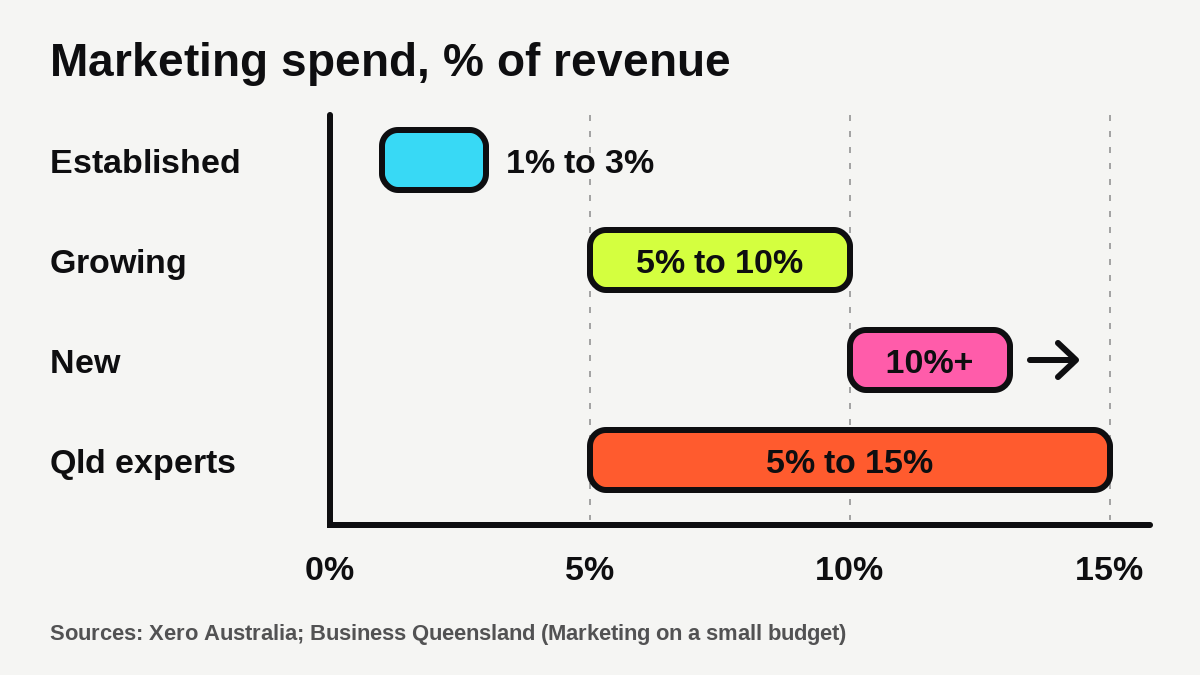
There is no single right number, but there is a sensible way to find yours. Published guidance for Australian small businesses runs from about 1% of revenue for a settled business to 10% or more for a new one. Business Queensland says some marketing experts suggest 5% to 15% of total revenue [1].
Those figures are a starting point, not a rule. The same page adds that many businesses are limited more by what they can afford than by what they should ideally spend, and that the real aim is a positive return on investment [1]. So your marketing budget is the amount you can afford to spend, on activities you can measure, at the stage your business is in right now.
This guide gives you the ranges, a worked example in dollars, a way to split the money, and a simple routine to check it is paying off.
How much should a small business spend on marketing?
Start with your stage. Xero's Australian guide gives three bands of revenue [3]:
| Business stage | Suggested spend (% of revenue) | What the money is for |
|---|---|---|
| Established, steady | 1% to 3% | Keeping your name in front of past and current customers [3] |
| Growth-focused | 5% to 10% | Expanding into new customers or areas [3] |
| New business | 10% or more | Building awareness from nothing [3] |
Business Queensland's wider range of 5% to 15% sits at the top of that table [1]. Treat it as the upper end for businesses pushing hard to grow, not a target every business should hit.
What does that look like in dollars?
Say your business turned over $400,000 last year. The bands above work out like this (our arithmetic on the cited percentages):
- Established (1% to 3%): $4,000 to $12,000 a year, or about $330 to $1,000 a month.
- Growth (5% to 10%): $20,000 to $40,000 a year, or about $1,670 to $3,330 a month.
- New business (10% or more): $40,000 or more a year, or about $3,330 a month and up.
If the growth number makes you wince, that is a useful signal. It is better to run a smaller plan you can keep for a year than a large one you cancel after two months.
Should you use revenue or profit?
Revenue is the usual yardstick in the sources above [3], and it is easy to work out. The catch is that a business with thin margins, such as a builder or a cafe, keeps far less of each dollar than a consultant does. If your margins are tight, start at the lower end of your band and work upwards only when you can see enquiries rising.
What does a new customer need to be worth?
The percentage tells you what is normal. It does not tell you what is worth it. For that, you need two numbers: what a typical new customer pays you over time, and how much of that is profit.
If a new customer is worth $600 in profit to you over a couple of years, spending $100 to win one is a good deal. If a job nets you $80, spending $100 to win it is not. Business Queensland's advice is to aim for a positive return on investment [1], and this is what that means in practice. Our guide to what a customer is worth over time shows how to work out the profit figure.
You do not need a spreadsheet to start. Take last month's marketing spend, divide it by the number of new customers you can trace to it, and compare the result to the profit from an average customer. Our free scan shows where you are missing enquiries before you spend anything more.
What should you spend on first?
Before you spend on ads, spend on the things that already bring in customers cheaply. A survey of 296 Australian small business owners across 20 industries, reported by Dynamic Business, found that over seven in ten said word of mouth and referrals were the most effective approach. Social media was the second most common strategy, but over a third said no social platform had worked for them [4].
That fits with Business Queensland's list of free or low-cost options, which includes [1]:
- listings on location-based online directories;
- community and industry events;
- partnering with complementary local businesses, for example a joint competition or shared vouchers;
- encouraging word of mouth and referrals, and managing online reviews well;
- free or low-cost tools for design, websites, email and social media scheduling.
If most of your customers live or work nearby, the same page says local marketing may matter most, and mass channels are often less effective [1]. For a tradie, a clinic or a salon, that usually means a strong Google profile before anything else. Our guide to the Google Business Profile checklist covers it, and how to get more Google reviews is the cheapest marketing most local businesses are not yet doing well.
Two more places where money quietly leaks are slow replies and a weak website. If enquiries are coming in but not turning into jobs, see our guide to how fast to reply to a new lead before buying more traffic. If you are planning a new site, the website cost calculator gives you a number to put in the budget.
How should you split your marketing budget?
Once you have a total, split it into three buckets. This is a simple way to organise the money, not a rule from the sources.
- Keep it running. Things you need every month: your Google profile, website hosting and any tool subscriptions. Unglamorous, but it is the base everything else sits on.
- Fund what works. Spend more on the channel where you can trace real enquiries, whether that is referrals, a local directory or a particular ad.
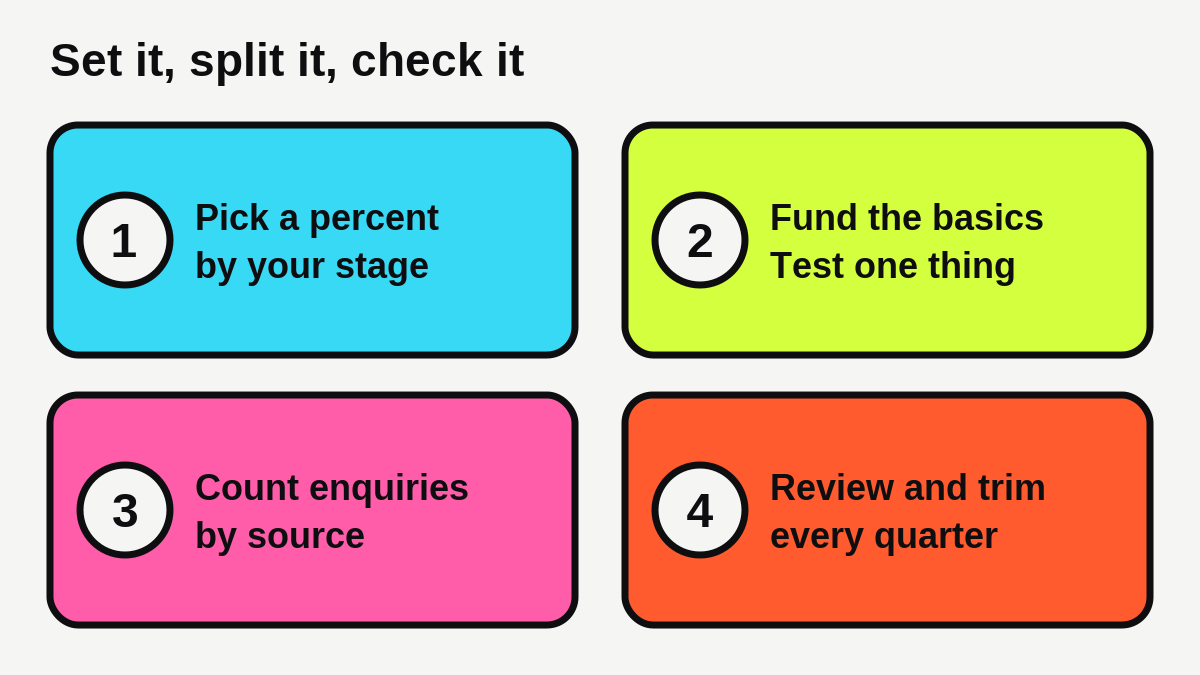
- Test one new thing. Xero's guide suggests putting about 20% of the marketing budget towards testing new tactics [3]. That 20% is a share of your marketing budget, not of your revenue.
On a $1,000 monthly budget, that could be roughly $300 for the basics, $500 on what is working and $200 on one experiment. Change one thing at a time, so you can tell what made the difference.
What if you run Google Ads?
Paid search is the channel where budgets most often get away from owners, so know how the limits work. In Google Ads you set an average daily budget. For most campaigns, the daily spending limit, which is the most you can be billed on a given day, is two times that average. The monthly limit, the most you can pay over a month, is 30.4 times the average daily budget [6].
So a campaign set to $20 a day can be billed up to $40 on a busy day, and up to about $608 across a month. Plan your cash around the monthly figure and check the campaign weekly, especially while you are still learning what works. To work out whether ads can pay for themselves at all, see our guide on whether Google Ads is worth it for a local business.
How do you know your marketing is paying off?
The business.gov.au planning guidance says to analyse the results of your marketing activities to see what worked, then remove the activities that did not [2]. It also suggests writing your goals so that success is easy to measure, and listing the estimated cost and timing of each activity [2].
Here is a light version you can keep up:
- Ask every new customer how they found you. Write the answer down. A simple list in a notebook or your CRM is enough.
- Count enquiries by source each month. Calls, forms, messages and walk-ins.
- Give each test a fair run. Three months is a reasonable start for most channels, though a paid ad can show early signs in weeks.
- Cut what is not working. Move that money to what is.
Time matters too. The survey reported by Dynamic Business found that about two in five owners spend roughly an hour a week on marketing, and just over a quarter spend no time on it [4]. If you are in those groups, a small, steady routine will usually beat a big campaign you run once and forget.
Is marketing spend tax deductible?
Often, yes, though the detail depends on what you buy. Reckon's article on marketing expenses lists paid advertising such as Meta Ads and Google Ads, signage, printing, marketing software, content creation, sponsorships and referral gifts as things the article treats as claimable [5]. It also notes that ongoing costs like a domain name are deductible in the year you pay, while building a website is a capital cost that is depreciated over time [5]. Where something is used for both business and personal purposes, only the business portion can be claimed, and you should keep receipts and a short note on how each expense was used [5].
This is general information only. Your accountant can tell you what applies to your business, and it is worth setting up a separate marketing line in your bookkeeping so the numbers are easy to find at tax time.
When is it worth paying someone to help?
If you are spending a few hundred dollars a month, you probably do not need an agency. You need a plan and an hour a week. If you are spending several thousand, an outside pair of eyes can pay for itself, as long as you can see what you are getting. Our guides on what social media management costs and what a small business website costs give you real price ranges to compare against. If you are not sure whether to hire anyone at all, see our guide to marketing agency, freelancer or DIY.
If you want help building a plan around your own numbers, our growth service looks at where your enquiries come from and where to put the next dollar. See pricing for what is involved. Trades such as plumbers and electricians often get the best early return from a strong local profile and reviews, so that is where we usually start.
What to do next
- Find last year's revenue and pick the percentage band that fits your stage [3].
- Turn it into a monthly dollar figure and write down where each dollar goes, using the three buckets above.
- Cover the cheap basics first: your Google profile, reviews, referrals and fast replies [1][4].
- Hold back about a fifth for one test [3], and give it a fair run.
- Ask every new customer how they found you, and review the numbers each month [2].
- Cut what does not work and move the money to what does [2].
If you want a second opinion on where your marketing is leaking enquiries, the free visibility scan is a good first step.
Stop losing jobs to missed calls.
Growth Systems texts back missed calls, answers messages and asks for reviews, on its own.
Sources
- [1]Marketing on a small budget · Business Queensland (Queensland Government) · accessed 10 November 2026
- [2]Develop your marketing plan · business.gov.au (Australian Government) · accessed 10 November 2026
- [3]Small business marketing guide: strategy, plan and tips · Xero Australia · accessed 10 November 2026
- [4]What marketing works best for small businesses? · Dynamic Business · accessed 10 November 2026
- [5]Small Business Marketing Expenses: What You Can Claim · Reckon · accessed 10 November 2026
- [6]About spending limits - Google Ads Help · Google · accessed 10 November 2026