Does Facebook still work for a local business?
Facebook still reaches most Australians, but a Page alone rarely brings enquiries. Here is when Facebook for local business is worth your time, and when not.
By the Omniwink team · 29 October 2026 · 8 min read
Listen to the summary· 2 min

Yes, Facebook still works for local businesses, but as a shop window and a way to be reachable, not as a free source of leads. Around 17.7 million people in Australia can be reached with ads on Facebook, which is about 82.8 percent of adults [1]. Your customers are there. What has changed is that you can no longer post now and then and expect the phone to ring.
Whether Facebook is worth your time for local business depends on how your customers find you. If they browse, compare and chat before they buy (a cafe, a salon, a gym), a lively Page helps. If they search Google when something goes wrong (a burst pipe, a flat battery), your time may be better spent on your Google Business Profile first.
This guide covers who is actually on Facebook, what the data says about how Australian small businesses use it, what free posting can and cannot do, and a simple plan if you decide to keep going.
Is anyone still using Facebook in Australia?
Yes, a lot of people. DataReportal's Digital 2026 report, using Meta's advertising tools, put Facebook's audience in Australia at 17.7 million in late 2025, up 4.4 percent on a year earlier. Instagram sat at 15.2 million [1]. These are advertising reach estimates, and Meta itself says an estimated audience size is not a proxy for monthly or daily active users [1]. Read them as "the number of people Facebook says it can show ads to".
Business Queensland describes Facebook as widely used across all ages, and great for connecting to the 18 to 44 age group [4]. So for most local businesses, the audience is not the problem. Getting seen by that audience, and turning it into customers, is.
How many Australian small businesses use Facebook?
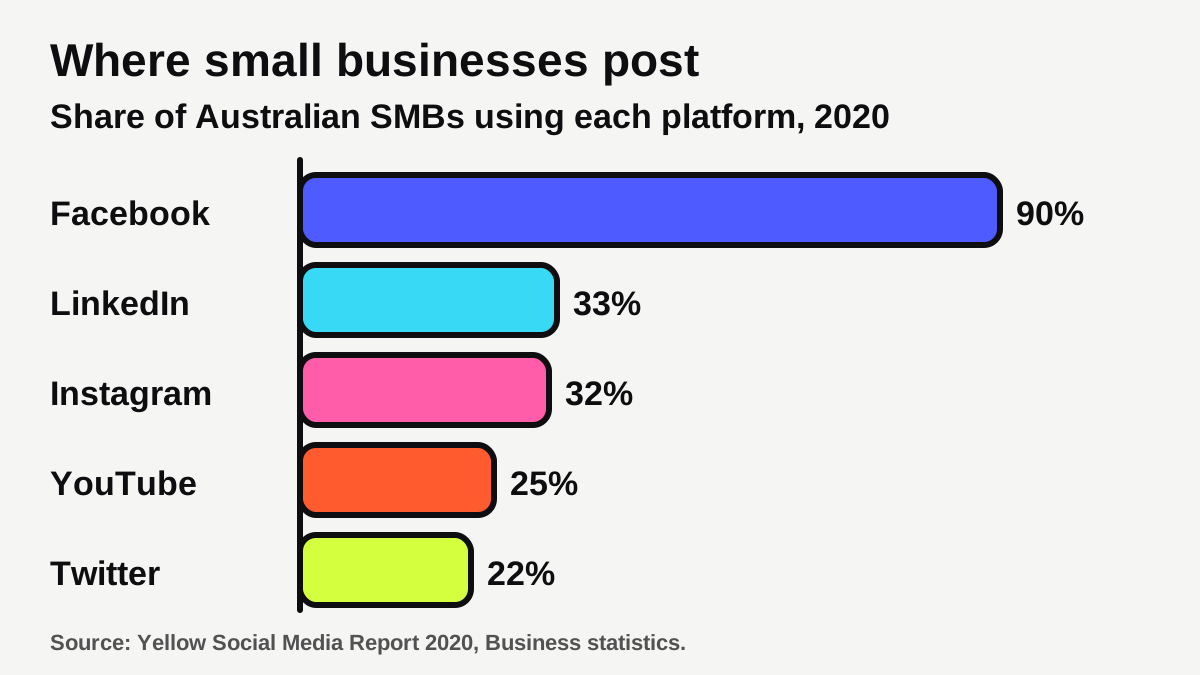
Nearly all of the ones on social media. The Yellow Social Media Report 2020 surveyed 1,020 small and medium businesses and found 90 percent used Facebook, well ahead of LinkedIn (33 percent), Instagram (32 percent), YouTube (25 percent) and Twitter (22 percent) [2]. The 2018 edition found the same 90 percent figure among small businesses on social media [3].
Those reports are a few years old, and platforms have moved on, so treat them as a picture of habits, not a current count. The useful part is what businesses said they got out of it. Most used social media for two-way conversations with customers (63 percent). Promoting the business (33 percent), awareness (28 percent) and generating sales (17 percent) came further down the list [2].
In other words, small businesses mostly treat Facebook as a place to talk to customers, not a sales machine. That fits what Facebook is good at.
Does posting on a Facebook Page still get you seen?
Less than it used to, and Buffer is blunt about it: reaching a target audience for free has become harder, though not impossible [5]. Buffer's guide does not give a figure for the share of your followers who see a typical post [5], so be wary of anyone quoting you a precise number.
What do people respond to? Socialinsider analysed about 25 million organic posts from business Pages with 1,000 to 1 million followers, measuring engagement (reactions, comments and shares) as a percentage of followers. For 2025 it found text status posts averaged 0.20 percent, Reels and albums 0.18 percent, single images 0.15 percent and link posts just 0.05 percent [6]. Those are small numbers across the board, which is the point: organic engagement on Pages is modest, and posts that send people off Facebook do worst.
Buffer adds that photos drive the most engagement while Reels reach the widest audience, and that Meta's own report found 97.3 percent of US post views went to posts without a link [5]. So post the useful thing on Facebook itself, and keep links for the bits that need them.
Is it still worth posting if reach is low?
Yes, for three reasons. Your Page is where people check you out before they ring. It is where past customers see you are still trading. And it gives you something to point people to from a link in bio page or a printed QR code. A Page that has not been touched for a year looks like a business that has closed.
What actually works on Facebook for a local business?
Not much is magic, but a few habits pay off.
Reply fast
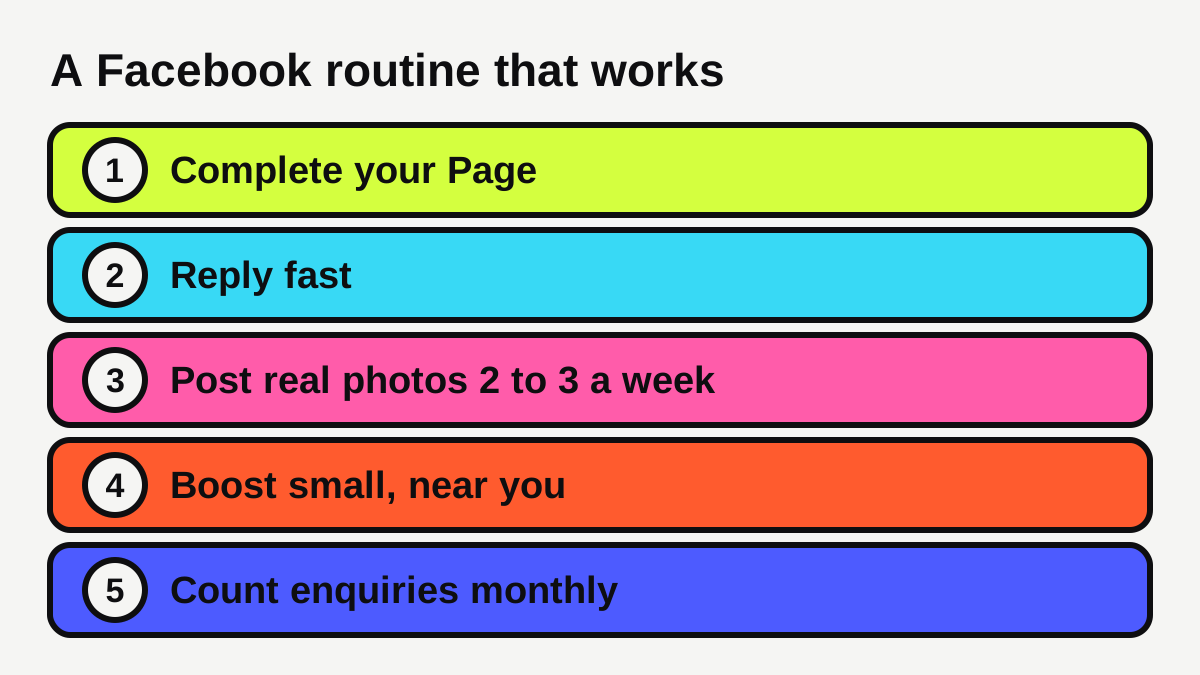
Buffer says replying to comments is the part of Facebook the algorithm rewards most heavily [5]. It also helps customers. Meta Business Suite brings messages, comments and reviews into one inbox, and lets you set automatic replies with your hours and contact details [7]. Speed matters on messages as much as on any enquiry, as our guide to how fast to reply to new leads explains.
Show real work
Photos get the most engagement [5]. For a tradie that means finished jobs. For a salon, a cafe or a gym, it means the people, the product and the place. If you are short of ideas, our free social post ideas tool gives you prompts for your type of business.
Post at a rhythm you can keep
Buffer's rule of thumb is that Facebook is worth the time if you can commit to two or three posts a week for at least three months [5]. For more on pace, see our guide to how often a small business should post on social media.
Consider a community Group
Buffer calls starting a Facebook Group one of the easiest ways to build an online community and grow organic reach, but the author's own group has about 470 members and takes active work, including messaging new members directly because a pinned welcome post went unread [5]. A Group suits a gym, a school-run business or a hobby shop more than a plumber.
Use paid reach carefully
Buffer says boosted posts can start at about $1 a day for quick visibility on a post that is already doing well [5]. In the Yellow 2020 survey, 37 percent of small and medium businesses had paid to advertise on social media, and 83 percent of those had used Facebook. The average annual spend on social advertising was $7,586, and about 80 percent said social media was an effective advertising tool [2]. That is self-reported opinion, not proof that every dollar worked, so start small and track what comes in.
Which local businesses should use Facebook, and which should not?
| Business type | Facebook fit | Why |
|---|---|---|
| Cafes, restaurants, salons, gyms | Strong | Visual, regular news, customers like to follow and chat (see cafes, salons) |
| Retail and community-based services | Strong | Events, specials and local Groups suit the platform |
| Tradies and home services | Medium | Good for proof of work and quick messages, but Google brings urgent jobs |
| Clinics, accountants, brokers | Medium | Helpful for trust and education, with strict advertising rules for health and finance |
This is a general guide, not a rule. The Yellow 2018 report found that businesses without social media mostly cited a perceived lack of benefit as the main barrier [3]. If your customers never see you on Facebook and you cannot say why you would be there, you are allowed to decide it is not for you.
For health businesses, AHPRA's advertising rules apply on Facebook as much as anywhere (no testimonials about clinical care, no promised outcomes). For finance, keep posts general. Nothing here is personal advice.
How do you know if Facebook is working for you?
Most businesses do not know. Yellow's 2020 survey found only 31 percent of small and medium businesses measured their return on investment for social media. Among those that did, the most common methods were engagement statistics (60 percent) and asking customers in person or by email (58 percent) [2]. In 2018, only 21 percent of small businesses did [3].
You can do better with a simple habit. Add a "how did you hear about us?" question to your booking or quote process. Count enquiries that start in Facebook messages. Check Insights in Meta Business Suite once a month [7]. If after three months you are getting nothing, change the approach, as Business Queensland advises when a tactic is not working [4], or spend the time elsewhere.
What are the risks of relying on Facebook?
Business Queensland lists several: platforms can close accounts without notice, wrong information and bad reviews can spread quickly, and poor management can hurt your reputation because customers expect quick replies [4]. Its answer is to build your own website, grow an email list and avoid relying only on third-party platforms [4].
That is the strongest argument for treating Facebook as one part of your marketing. If you want Google reviews as well, our guide to how to get more Google reviews shows how. If you are weighing outside help, what social media management costs gives realistic numbers.
What to do next
- Check your Page this week: opening hours, phone number, website link, a current cover photo and a pinned post with your main offer.
- Turn on automatic replies and check messages daily [7].
- Plan two or three posts a week with real photos from your work, for at least three months [5].
- If you want more reach, boost one good post to people near you with a small budget, and track what it brings [5].
- Ask every new customer how they found you, and review the answers monthly.
If posting is the part you will not get to, our content service can plan and write it for you. If you are not sure where your business shows up online, a free visibility scan is a quick place to start.
Want this done for you every weekday?
The Content Engine writes, designs and posts in your voice.
Sources
- [1]Digital 2026: Australia · DataReportal (Kepios) · accessed 29 October 2026
- [2]Yellow Social Media Report 2020: Business statistics · Yellow · accessed 29 October 2026
- [3]Yellow Social Media Report 2018 - Part Two: Businesses · Yellow (formerly Sensis) · accessed 29 October 2026
- [4]Social media for business · Business Queensland (Queensland Government) · accessed 29 October 2026
- [5]Facebook Marketing Strategy: Your Ultimate 2026 Guide · Buffer · accessed 29 October 2026
- [6]2026 Organic Facebook Engagement Benchmarks · Socialinsider · accessed 29 October 2026
- [7]Meta Business Suite: What It Is and How to Use It · Buffer · accessed 29 October 2026