Instagram or Facebook for a local business: which first?
Instagram or Facebook for your local business? Compare audience, effort and ad reach, see what suits tradies, salons and cafes, and pick one to start.
By the Omniwink team · 3 November 2026 · 9 min read
Listen to the summary· 2 min

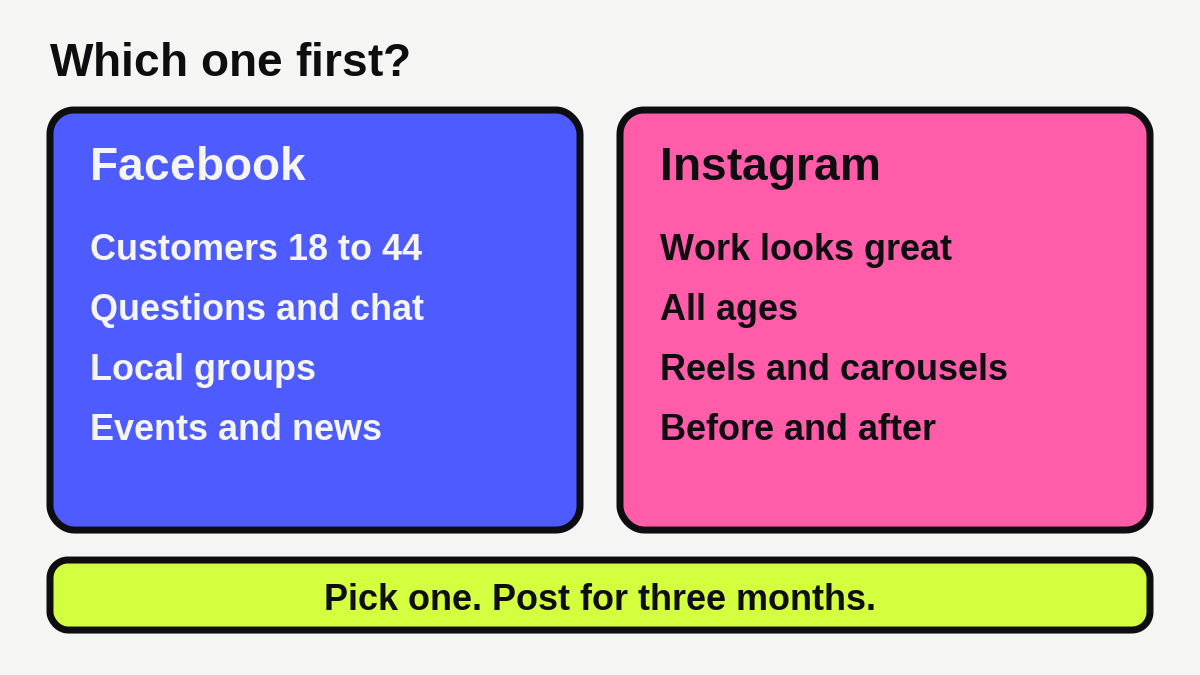
If you can only start with one, pick Facebook when your customers are adults who like to ask questions, join local groups and follow local news. Pick Instagram when what you sell looks good in a photo or a short video and you want to be seen by a broad age range. Either way, choose the one you can keep up for at least three months, because the habit matters more than the platform.
The question of Instagram or Facebook for a local business comes down to three things: who your customers are, what you can show them, and how much time you have. Facebook reaches about 17.7 million people in Australia with ads (82.8 percent of adults) and Instagram about 15.2 million (69.2 percent) [1]. Neither is a bad choice, and they are owned by the same company, so the skills carry over.
This guide compares the two side by side, with Australian numbers, and then shows which kind of business tends to suit which. If you want the detail on one platform, our guides to whether Facebook still works for a local business and what to post on Instagram go deeper.
How big are Facebook and Instagram in Australia?
Both are big. DataReportal's Digital 2026 report, based on Meta's advertising tools, put Facebook's ad audience in Australia at 17.7 million in late 2025, up 4.4 percent on a year earlier. Instagram's was 15.2 million, up 8.6 percent [1].
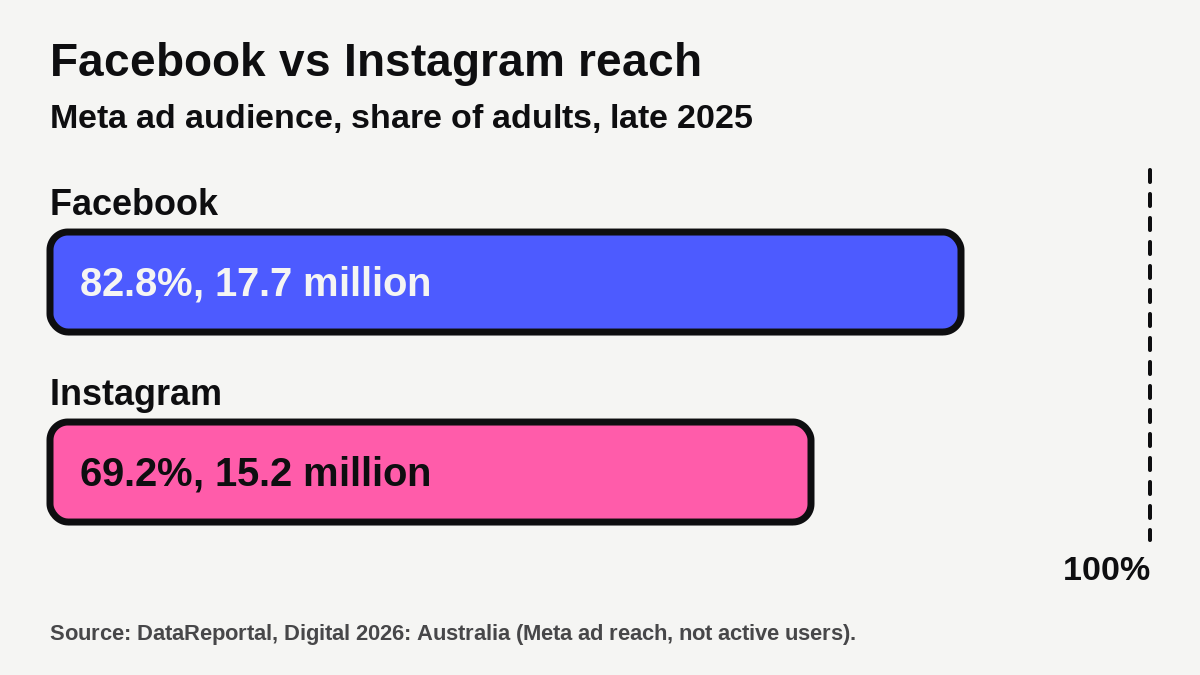
Two cautions. First, these are advertising reach estimates, and Meta says an estimated audience size is not a proxy for monthly or daily active users, or for engagement [1]. Read them as "how many people Meta says it can show ads to". Second, the same report shows slightly more women than men in both ad audiences: 50.9 percent of Facebook's adult audience is female against 54.8 percent of Instagram's [1]. That is a small tilt, not a reason to choose a platform.
The takeaway: your customers are almost certainly on both. The choice is about where you can show up best, not where the audience is.
Who uses Facebook, and who uses Instagram?
Age is the clearest difference. Business Queensland describes Facebook as great for connecting with the 18 to 44 age group, and Instagram as great for reaching all ages [2]. Buffer's guides point the same way: Facebook is especially strong for Millennials, Gen X and niche communities [5], while more than half of Instagram's users are 34 or younger [6].
Buffer also says 62.3 percent of Instagram users aged 16 and over use it to follow or research brands and products [6]. So people do go to Instagram to look at businesses, which is useful if you sell something they can see. It is a worldwide figure, not an Australian one, so treat it as a guide to behaviour rather than a local count.
How do small businesses use each platform?
Facebook came first and still leads. In the Yellow Social Media Report 2020, which surveyed 1,020 small and medium businesses, 90 percent used Facebook, about one in three used LinkedIn (33 percent) and Instagram (32 percent) [3]. Of the businesses that had paid to advertise on social media, 83 percent had used Facebook and 22 percent Instagram [3].
Instagram was catching up even earlier. The 2018 edition found Instagram had become the second most popular platform for small businesses, up eight points to 27 percent. Only 10 percent of small businesses had advertised on it, though [4].
Those surveys are a few years old, so use them as a picture of habits, not a current count. What stands out is why people use social media at all. Almost two thirds of small and medium businesses (63 percent) used it for two-way conversations with customers. Promoting the business (33 percent), awareness (28 percent) and generating sales (17 percent) came after [3]. That fits the next section: Facebook leans into conversation, and Instagram leans into showing.
What is each platform actually good at?
| Core strength | Conversation, local groups, events, messages | Photos, Reels and Stories that show your work |
| Audience | Strong for ages 18 to 44 [2] | Reaches all ages, skews younger [2][6] |
| What gets seen | Most post views go to posts without links [5] | Reels reach most, carousels engage most [6] |
| Ads | Most small businesses that advertise use it [3] | Used by fewer small businesses [3] |
| Effort | Two to three posts a week [5] | A few Reels, carousels and Stories a week [6] |
| Main risk | Low free reach on Pages [5] | Needs fresh visual content most weeks |
Facebook: the place for chat and community
Buffer says starting a Facebook Group is one of the easiest ways to build an online community, although it takes active work [5]. Pages are also where customers expect to find opening hours, messages and reviews. Free reach is limited: Buffer says reaching a target audience for free is harder, though not impossible [5]. Socialinsider's analysis of about 25 million posts from Facebook business Pages with 1,000 to 1 million followers found an overall engagement rate of 0.15 percent in 2025, measured as reactions, comments and shares divided by followers [7]. That is low, so plan to reply to people and use small paid boosts rather than rely on organic reach.
Buffer says boosted posts can start at about $1 a day, and Ads Manager campaigns work best with a $5 to $10 daily minimum [5].
Instagram: the place to show your work
Buffer says Reels see 36 percent more reach than other post types, while carousels get 12 percent more engagement [6]. Its advice is that a steady pace beats a heavy one: one Reel and two Stories a week is fine if you keep it up, and batching means you only need to be camera-ready once or twice a week [6]. Buffer's guide notes that Instagram shopping is currently only available in the United States, so do not count on it here [6].
Which suits your type of business?
This is general guidance, not a rule. Your own customers matter more than any table.
| Business | Lean towards | Why |
|---|---|---|
| Cafes, salons, gyms | Both, Instagram first if you have the photos | Visual, and people follow for news, specials and transformations |
| Tradies (plumbers, electricians, builders) | Facebook first | Good for local groups and quick messages, and finished jobs work on either |
| Cleaners, landscapers, car detailers | Instagram if you do before and after work | Visual results, photographed easily |
| Accountants, brokers | Facebook for trust, or neither | Education and reputation matter more than visuals |
| Clinics (dentists, physios) | Facebook, with care | AHPRA advertising rules apply: no testimonials about clinical care, no promised outcomes |
For trades, urgent jobs are usually found on Google, not social media. If you have not set up your Google Business Profile properly, do that before either platform. Our guide to local SEO for tradies explains where to start.
Should you use both, or just one?
Business Queensland says to choose one to three platforms based on your audience and goals, and be selective about where you spend time and money [2]. For a business owner already juggling jobs, one is usually enough to start. Get a routine of two or three posts a week working for three months [5], then add the second if you have the capacity.
If you do add the second, you do not need two sets of content. Take one real photo or short clip from a job, and write a slightly different caption for each. Reusing content is a fair way to cover both without doubling the work, and our guide to how often to post on social media shows a rhythm you can keep.
Whichever you pick, send people to something you own. Put your website and a link in bio page in your profile. Our guide to what to put in your link in bio covers what to include.
What are the risks of relying on either one?
Business Queensland lists several: platforms can shut accounts down without notice, wrong or negative information can spread quickly, and poor management can damage your reputation or sales because customers expect quick replies [2]. Both Facebook and Instagram sit with the same owner, so one decision on their side can affect both.
That is why your website, Google Business Profile and customer list matter. Business Queensland suggests building your own website and email list so you are not relying only on a third-party platform [2]. The Yellow reports also show most small businesses do not check whether it is working: in 2018 only 21 percent of small businesses measured their return on investment from social media [4], and in 2020 only 36 percent of small and medium businesses had a strategic plan for it [3].
How will you know which one is working?
Do not judge by followers or likes. Judge by enquiries.
- Add a "how did you hear about us?" question to your booking or quote process.
- Count enquiries that begin as a Facebook message or an Instagram direct message.
- Check each platform's insights once a month.
- After three months, double down on the one that brings real enquiries, and drop or reduce the other.
Buffer says results take a few months to show up, not days [5]. Give each platform a fair run before you decide.
What to do next
- Write down who your best customers are: age range, suburb, how they usually find you.
- Pick one platform this week using the table above. If it is a toss-up, choose the one where you already have photos to share.
- Tidy your profile: correct phone number and hours, a clear photo, your website link and a short description.
- Plan two or three posts a week from real work, for three months. Our free social post ideas tool gives prompts for your trade.
- Reply to every comment and message quickly.
- Ask each new customer how they found you, and review the answers monthly.
If the posting is the part you will not get to, our content service can plan and write it for you. If you are not sure how your business shows up online at the moment, a free visibility scan is a quick place to start. And if you are weighing outside help, see what social media management costs in Australia.
Want this done for you every weekday?
The Content Engine writes, designs and posts in your voice.
Sources
- [1]Digital 2026: Australia · DataReportal (Kepios) · accessed 3 November 2026
- [2]Social media for business · Business Queensland (Queensland Government) · accessed 3 November 2026
- [3]Yellow Social Media Report 2020: Business statistics · Yellow · accessed 3 November 2026
- [4]Yellow Social Media Report 2018 - Part Two: Businesses · Yellow (formerly Sensis) · accessed 3 November 2026
- [5]Facebook Marketing Strategy: Your Ultimate 2026 Guide · Buffer · accessed 3 November 2026
- [6]Instagram Marketing in 2026: The Complete Guide to Form Your Strategy (+ Best Practices) · Buffer · accessed 3 November 2026
- [7]2026 Organic Facebook Engagement Benchmarks · Socialinsider · accessed 3 November 2026